Do you want to learn the Russian B2 vocabulary in the most effective and efficient way possible?
If so, the Russian B2 Vocabulary Anki Deck is the best solution for you!
In this post I am going to explain everything you need to know about why you should use the Russian B2 Vocabulary Anki Deck, what it is, and how to get it!
Here’s a video that shows you the content of the Russian B2 Vocabulary Anki Deck:
If you would like to read rather than watch, then please go ahead and keep reading!
Why should you use the Russian B2 Vocabulary Anki Deck?
Practice the Russian B2 Vocabulary
The Russian B2 Vocabulary Anki Deck has 3172 flashcards. These flashcards contain every single concept that you need to know! This means you have a tremendous amount of exercises. The best part is that the exercises will adapt to your performance, creating a personalized practice experience.
This gives you a tailor-made practice deck. You will be able to practice every single facet of Russian B2 vocabulary.
Improve your Russian comprehension and pronunciation
All of the flashcards in the Russian B2 Vocabulary Anki Deck have audio files. Each word is accompanied by two audio files: one for the sentence it’s in and another for the word itself.
This means that you will know how the words and sentences are supposed to sound in Russian. This will greatly improve your Russian comprehension. Moreover, because you hear the audio, you also improve your own pronunciation.
Additionally, for further clarity, the International Phonetic Alphabet (IPA) is provided for all words and sentences. This means that you can check pronunciation whenever needed.
The best way to memorize the Russian B2 vocabulary
One of the biggest advantages of using the Russian B2 Vocabulary Anki Deck, is that it is the PERFECT tool for memorizing what you have learned. No longer will you keep forgetting what you studied!
Read more on the benefits of Anki in the next chapter!
Why is it so important to use Anki?
Have you ever studied for an exam and then forgotten everything a few days after the exam? It is a feeling that most of us experience.
In fact, according to Art Kohn Ph.D, a professor at Duke University, within 24 hours most of us forget an average of 70% of new information.
Often this would not be a problem. However, when it comes to language this can become a huge issue. Learning vocabulary and grammar to then forget them later on would be a disaster!
Anki prevents this from happening and ensures that you remember what you study. Let’s take a look at the 3 reasons why Anki is so effective.
Active recall
Active recall means that Anki asks you a question and you have to remember the answer. This is more powerful than passive learning and improves your memory.
When you retrieve information from your brain, you strengthen your ability to retain information and create connections in your brain between different concepts.
Spaced Repetition
Spaced repetition introduces new concepts in batches to you. A flashcard appears and if you know the answer the flashcard moves to the next batch. This batch will be shown to you at a later time. The more often you answer correctly the later the intervals become.
However, should you answer wrongly, the flashcard moves to the first batch again, and you will see it more often.
This system finds its origins in the spacing effect. The spacing effect illustrates how people learn better if reviews are spread out over time.
Ease
Anki takes care of all your scheduling. There’s no need to calculate when you need to practice which cards. Furthermore, Anki is available on both iOS and Android users, so you can download it on your smartphone and use it wherever you are.
Card Structure of the Russian B2 Vocabulary Anki Deck
All words in the Russian B2 Vocabulary Anki Deck are used in sentences to help you learn them in context. Each flashcard includes an image, IPA notation, and an audio file.
The image allows you to create a better memory with the word/concept that you are studying. You are linking a concept with a certain image.
The IPA notation is so you can know exactly how something is pronounced and be able to repeat that pronunciation yourself.
The audio file allows you to understand how something is pronounced in Russian. This will help you to improve your Russian comprehension.
Here is an extract, so you can hear what the audio sounds like in the Russian B2 Vocabulary Anki Deck. The IPA notation has been added too. There is also audio for the words and the plural versions of those words.
Окна спальни выходят на восток.
ˈoknə ˈspaɫʲnʲɪ vɨˈxodʲat nə vɐsˈtok
История этого города очень интересная.
iˈstorʲɪjə ˈetəvə ˈɡorədə ˈotɕɪnʲ ɪntʲɪˈrʲesnəjə
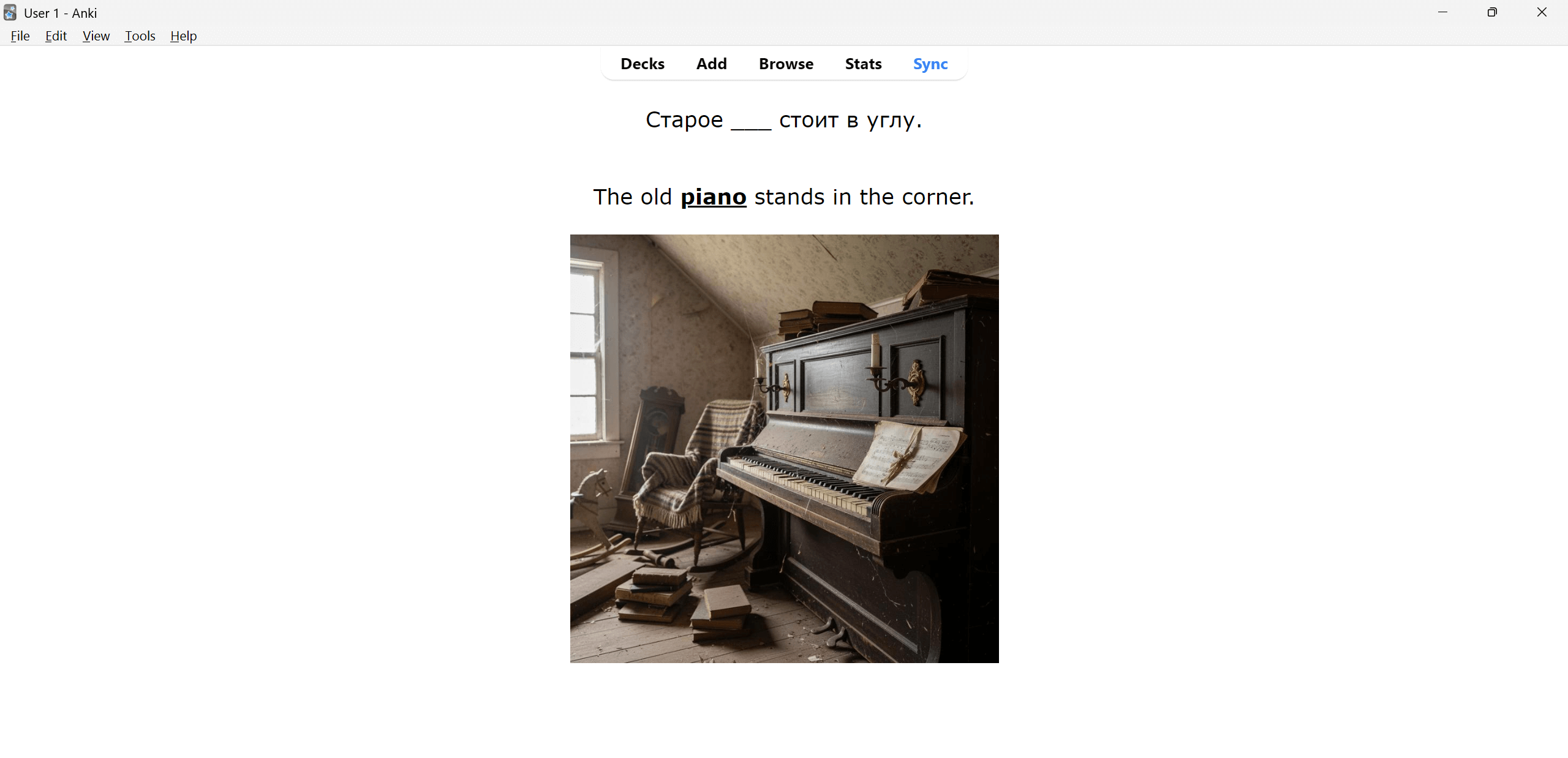
Старое пианино стоит в углу.
ˈstarəɪ pʲɪɐˈnʲinə stoɪt v‿uˈɡɫu
There are 2 card types in the Russian B2 Vocabulary Anki Deck.
Conjugate/Fill in the blank
On the front side, you will find a sentence in both Russian and English. This is accompanied by an image that shows the context of the sentence. In the Russian sentence, the word you need to know is missing and represented as underscores. In the English sentence, the word you need to know is bolded and underlined. You should determine what belongs in place of the underscores.
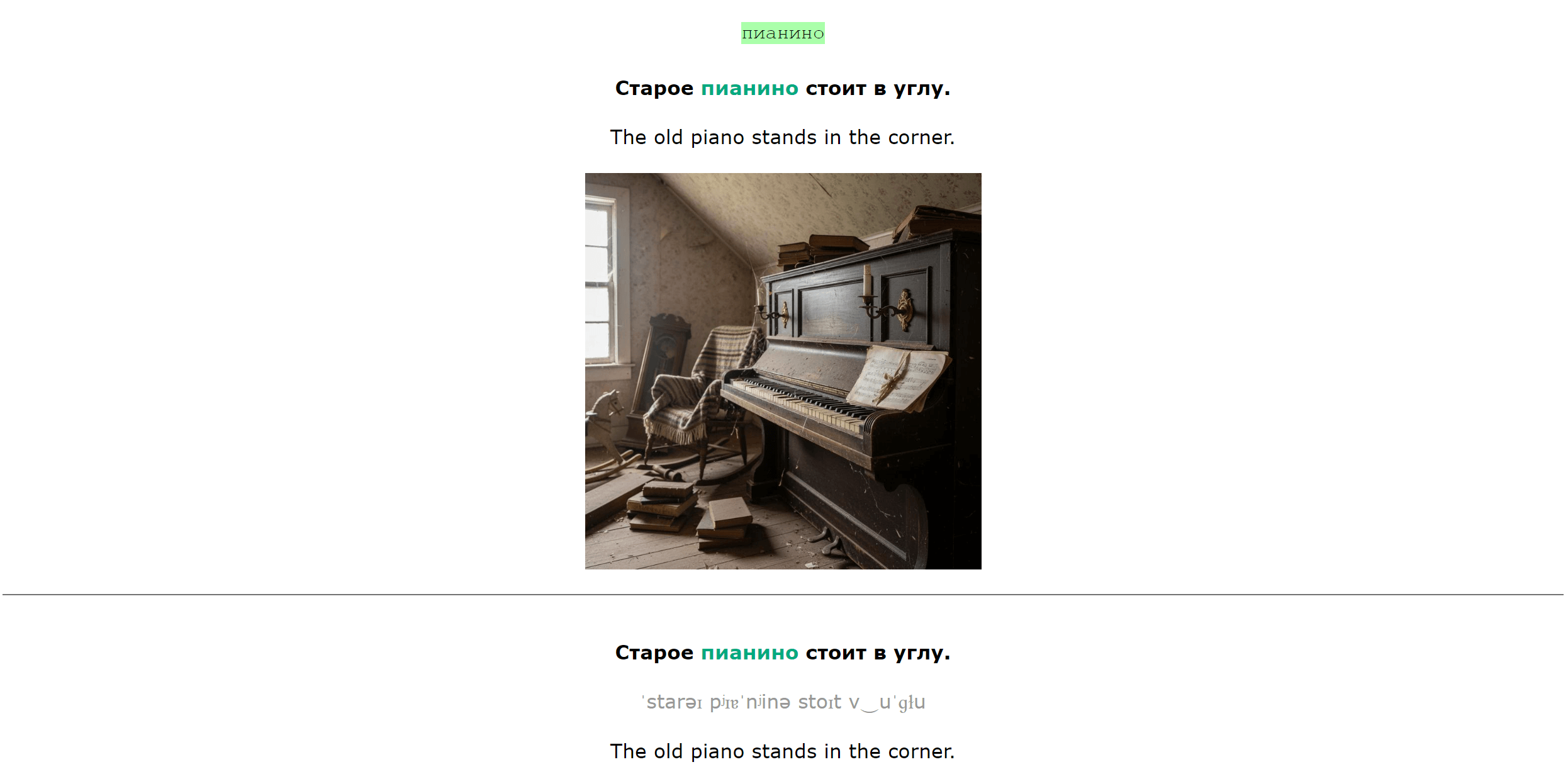
On the back, you will see the full Russian sentence with the target word highlighted by a colour so you can immediately spot the answer. Nouns are colour-coded by gender: bluefor masculine, pink for feminine, and green for neutral. This will help you remember the correct gender of nouns more easily. Everything else — verbs, adjectives, adverbs — is highlighted in indigo.
Below that you will find the IPA transcription of the sentence, the English translation, and an audio file of the sentence.
You will also see just the Russian word, its IPA transcription, its English translation, and an audio file of the word. This gives you the opportunity to see and hear the word in a sentence and just by itself.
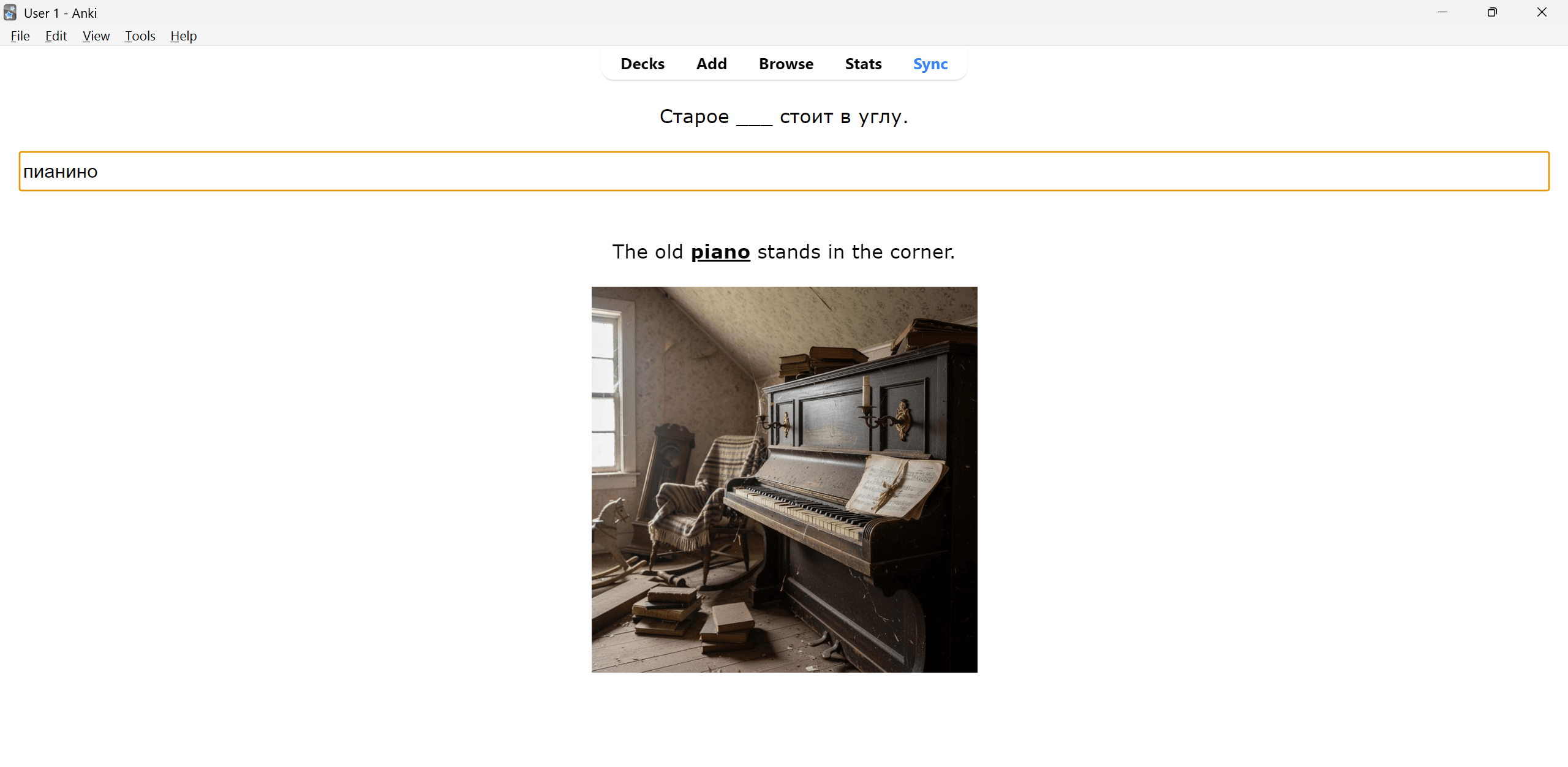
Type the correct Russian word
This is the same as the first card, however in this one, you have to type the correct word. You will see if you made any errors, or if you were correct.
This helps improve your writing skills in Russian.
Course Content of the Russian B2 Vocabulary Anki Deck
The Russian B2 Vocabulary Anki Deck contains a total of 3172 Flashcards across 7 chapters, which are further divided into a total of 25 lessons.
Every chapter has 1 lesson except for the nouns chapter, which contains 19 lessons. These 19 lessons correspond to the 19 categories into which the nouns are divided.
I am going to show you exactly what’s inside the Russian B2 Vocabulary Anki Deck, chapter by chapter.
Please note that for every sentence there are 2 card types.
The card types have been explained in the previous chapter.
Chapter 1: Pronouns
The first chapter of the Russian B2 Vocabulary Anki Deck is about subject pronouns!
The chapter has 4 Flashcards.
These are the words that you will be learning:
whom
whoever
Chapter 2: Conjunctions
The second chapter of the Russian B2 Vocabulary Anki Deck is about conjunctions!
The chapter has 10 Flashcards.
These are the words that you will be learning:
plus
whereas
wherever
yet
whilst
Chapter 3: Verbs
The third chapter of the Russian B2 Vocabulary Anki Deck is about verbs!
The chapter has 726 Flashcards.
These are the words that you will be learning:
to abandon
to absorb
to absorb
to accommodate (provide somebody with a room or place to sleep, live or sit)
to accompany
to accomplish
to accuse
to acknowledge
to acquire
to activate
to adapt
to address (give attention to something)
to adjust
to adopt
to advance (develop)
to aid
to alarm
to alter
to anticipate
to appeal (make a deeply felt request)
to approach
to approve
to arise (stand up)
to assess
to assign
to associate
to assume
to assure
to attempt
to back (support)
to bar (prevent)
to battle
to beg
to bet
to bid
to bill
to blame
to boost (increase)
to border (land area)
the broadcast (programme)
to calculate
to cancel
to capture
to chain
to chair
to challenge
to chart (track progress, changes)
to chase
to cheer
to chop
to cite
to clarify
to classify (sort by class or kind)
to collapse
to comfort
to command
to commission (order or authorize the production of something)
to compose
to comprise
to concern
to conduct
to confess
to conflict
to construct
to consult (go to somebody for information or advice)