
Are you looking for the best Arabic Anki Decks?
If so, look no further!
With over 125 downloads and only 5-star reviews, we can say with great confidence that we have the best Arabic Anki Decks!
These decks teach Modern Standard Arabic (MSA). This is the standard form of Arabic used in books, schools, news, work, and formal situations.
MSA is ideal because it gives you Arabic that is understood across the Arabic-speaking world. It does not limit you to one local dialect. This lets you communicate with people all over the Arabic-speaking world.
In this article, I am going to explain everything you need to know about why you should use the Arabic Anki Decks, what they are, and how to get them!
Why should you use the Arabic Anki Decks?
Additionally, for further clarity, the International Phonetic Alphabet (IPA) is provided for all words and sentences. This means that you can check pronunciation whenever needed.
One of the biggest advantages of using the Arabic Anki Decks, is that it is the PERFECT tool for memorizing what you have learned. No longer will you keep forgetting what you studied!
Read more on the benefits of Anki in the next chapter!
Why is it so important to use Anki?

Card Structure of the Arabic Anki Decks
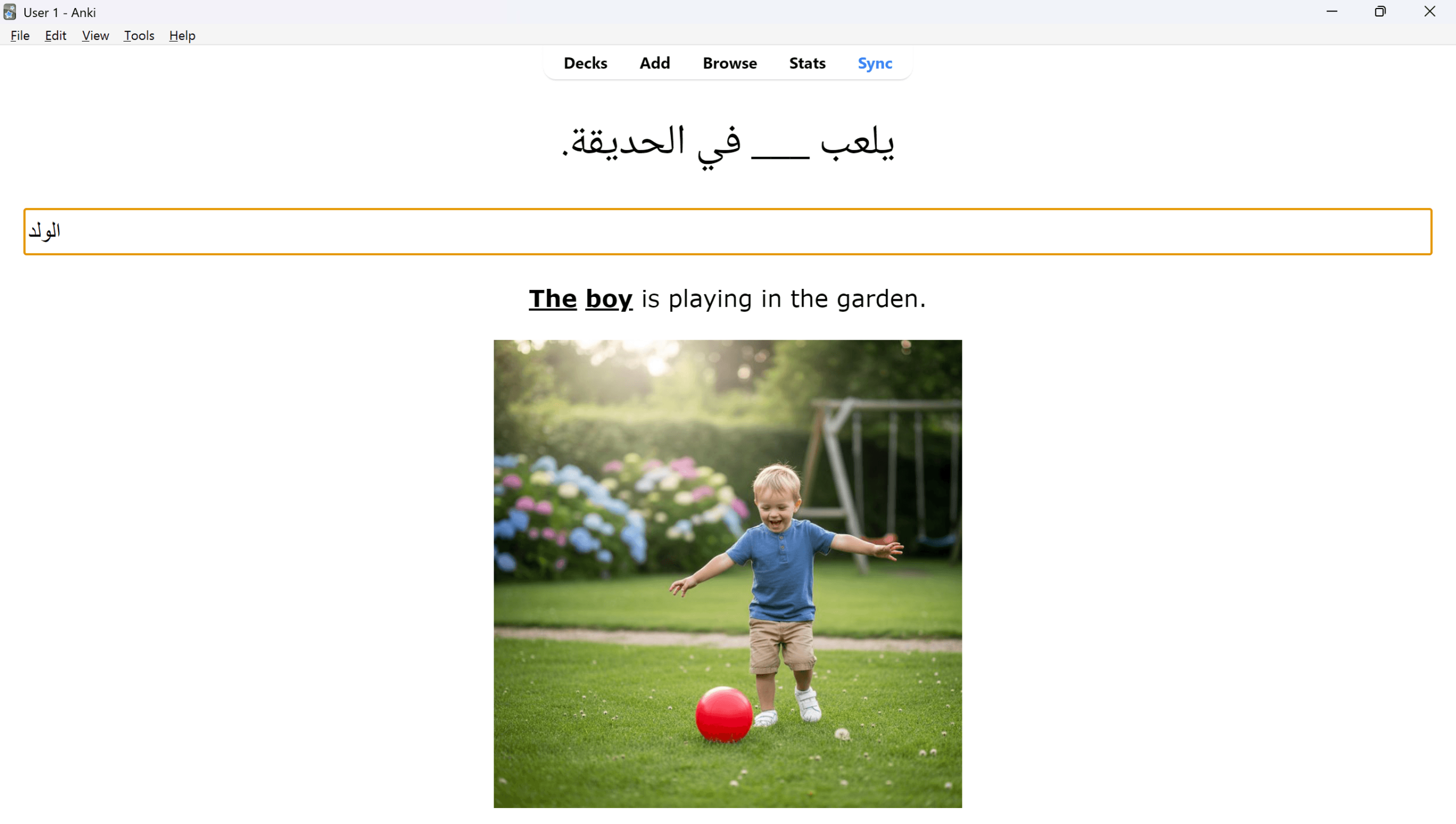
All words in the Arabic Anki Decks are used in sentences to help you learn them in context. Each flashcard includes an image, IPA notation, and an audio file.
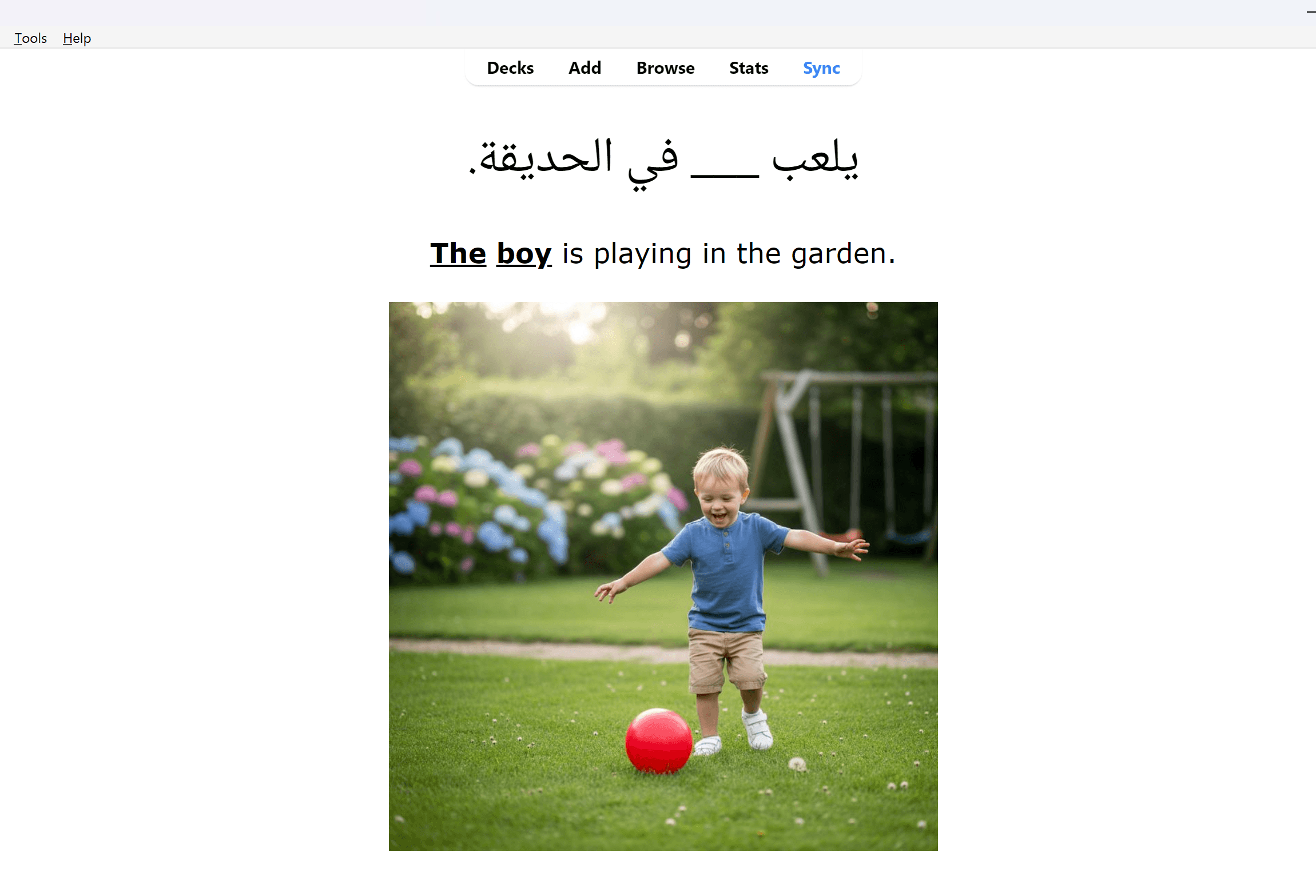
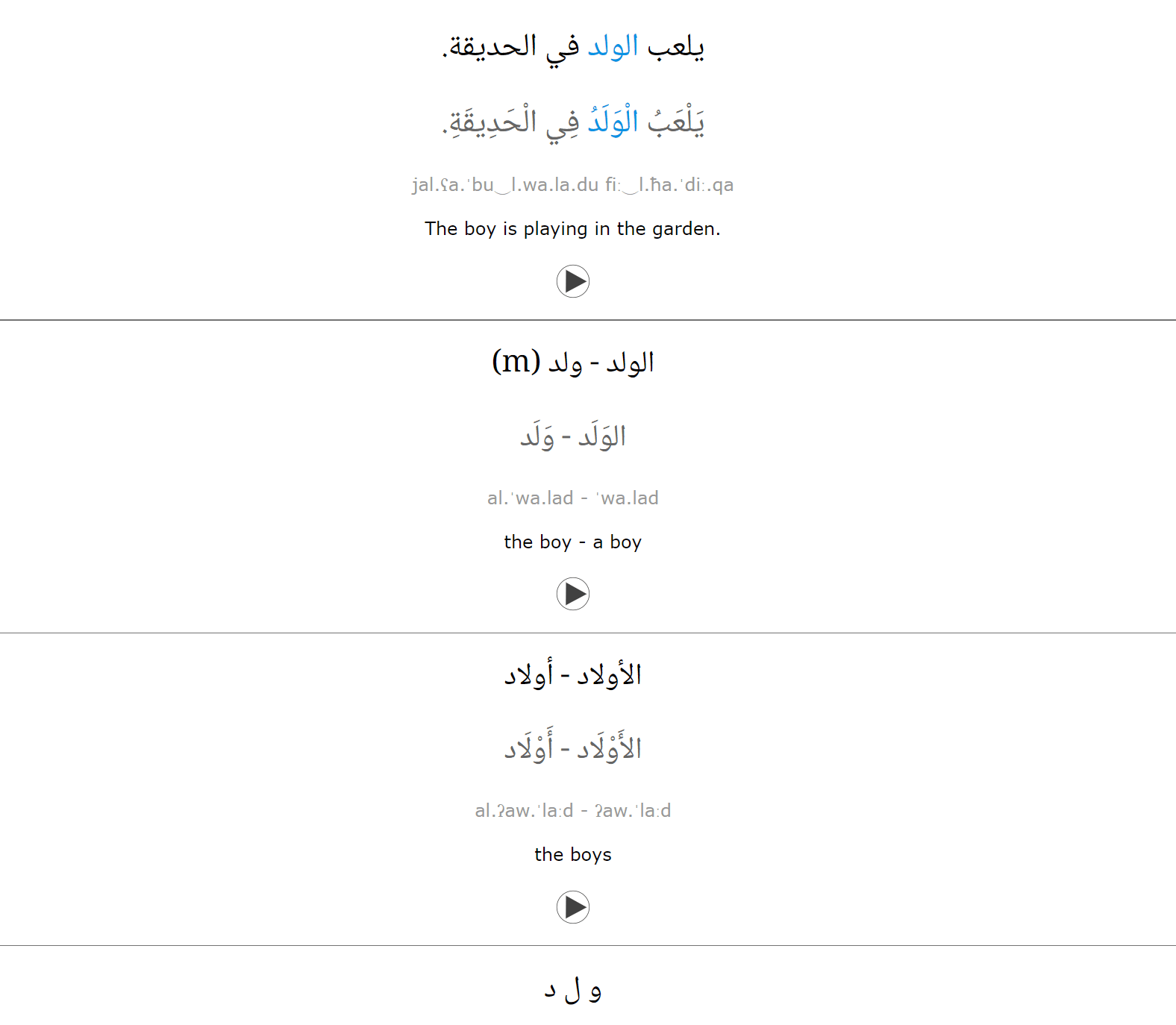
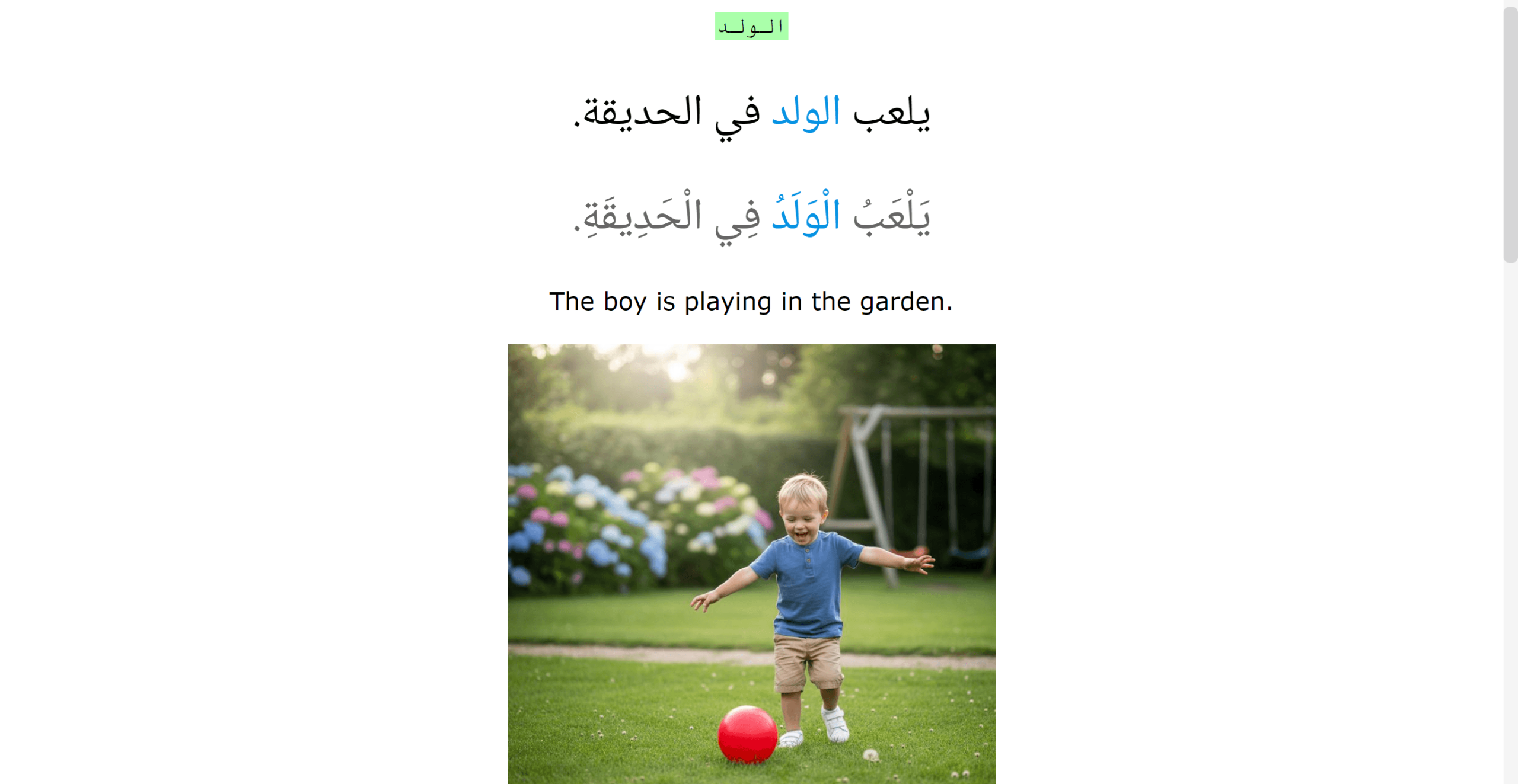
On the back, you will see the full Arabic sentence with the target word highlighted. For nouns, the target word is colour-coded by gender: masculine nouns appear in blue, and feminine nouns appear in pink. All other word classes (verbs, adjectives, adverbs, prepositions, etc.) appear in indigo. This way, you can immediately spot the answer and learn noun genders at the same time.
Below the answer sentence, you will find the same sentence with full harakat. These are the small marks above and below the Arabic letters. They show you exactly how each word is pronounced. Below that you will find the IPA transcription of the sentence, the English translation, and an audio file of the sentence.
For verbs, the card shows two forms: the past tense and the present tense (e.g. أغلق – يغلق). These are the two most common forms you will encounter when reading and speaking Arabic. In English, you can often guess one form from the other (e.g. close → closes). In Arabic, the two forms look quite different. That is why both are shown.
For nouns, the card shows both the definite and indefinite forms (e.g. الولد – ولد), along with the gender marker (m/f). The plural form is shown separately with both its definite and indefinite forms.
For adjectives, the card shows the masculine and feminine singular forms (e.g. كبير – كبيرة), and the plural form below.
Each word is accompanied by its harakat form, IPA transcription, English translation, and audio file.
When possible, the Arabic root letters are shown at the bottom (e.g. و ل د). This gives insight into the word’s origin and related words.
Arabic A1 Vocabulary Anki Deck
The Arabic A1 Vocabulary Anki Deck is your first big step in your Arabic learning journey.
It will take about 30-40 hours to finish.
Once you are done you will have acquired the following skills:
- You are able to understand familiar words and very basic phrases concerning yourself, your family, and when people speak slowly and clearly.
- You can write short and simple postcards, and forms requiring personal details. Think of cards for holidays and subscription forms.
- You can use simple phrases. When conversing others need to speak slowly and help you in the conversation.
- You can understand familiar names, words, and very simple sentences, for example on notices and posters or in catalogues.
Arabic A2 Vocabulary Anki Deck
The Arabic A2 Vocabulary Anki Deck is your second big step in your Arabic learning journey.
It will take you cumulatively 80-100 hours to finish. So the hours reflect how much time you need for Arabic A1 + Arabic A2.
This means that this is the time it takes to finish everything before this and this one.
Once you are done you will have acquired the following skills:
- You can understand high-frequency words and often used expressions that are personally relevant (e.g. shopping, employment, and geography).
- You are able to write a simple letter and a simple message. You are capable of thanking someone for something that he or she has done.
- You can communicate in simple and routine tasks requiring a simple and direct exchange of information on familiar topics and activities.
- You can read very short, simple texts such as advertisements, prospectuses, menus and timetables and you can understand short simple personal letters.
Arabic B1 Vocabulary Anki Deck
The Arabic B1 Vocabulary Anki Deck is your third big step in your Arabic learning journey.
It will take you cumulatively 180-200 hours to finish. So the hours reflect how much time you need for Arabic A1 + Arabic A2 + Arabic B1.
Once you are done you will have acquired the following skills:
- You can read very short, simple texts such as advertisements, prospectuses, menus and timetables and you can understand short simple personal letters.
- You can write simple connected text on topics that are familiar or of personal interest, and write personal letters describing your experiences.
- You can describe experiences and events, dreams, hopes and ambitions and give reasons and explanations for opinions and plans.
- You can understand texts that consist mainly of high-frequency everyday or job-related language, and letters containing: events, feelings, and wishes.
Arabic B2 Vocabulary Anki Deck
The Arabic B2 Anki Deck is your fourth big step in your Arabic learning journey.
It will take you cumulatively 280-325 hours to finish. So the hours reflect how much time you need for Arabic A1 + Arabic A2 + Arabic B1 + Arabic B2.
Once you are done you will have acquired the following skills: