
Do you want to know how to learn Dutch A1 in the most effective and efficient way possible?
If so, the Dutch A1 Grammar Anki Deck is the best solution for you!
In this post I am going to explain everything you need to know about why you should use the Dutch A1 Grammar Anki Deck, what it is, and how to get it!
Why should you use this Dutch A1 Grammar Anki Deck?
Additionally, for further clarity, the International Phonetic Alphabet (IPA) is provided for every sentence. This means that you can check pronunciation whenever needed.
One of the biggest advantages of using the Dutch A1 Grammar Anki Deck, is that it is the PERFECT tool for memorizing what you have learned. No longer will you keep forgetting what you studied!
Read more on the benefits of Anki in the next chapter!
Why is it so important to use Anki?

Card Structure of the Dutch A1 Grammar Anki Deck
Every grammar point in the Dutch A1 Grammar Anki Deck is practised in full sentences, so you learn it in context. Each flashcard includes an image, IPA notation, an explanation, and an audio file.
The image allows you to create a better memory with the word/concept that you are studying. You are linking a concept with a certain image.
The IPA notation shows you exactly how the sentence is pronounced, so you can repeat that pronunciation yourself.
The explanation is there so you always understand why the answer is correct, even if you have forgotten the rule.
The audio file allows you to understand how something is pronounced in Dutch. This will help you to improve your Dutch comprehension.
Here is an extract, so you can hear what the audio sounds like in the Dutch A1 Grammar Anki Deck.
There are 2 card types in the Dutch A1 Grammar Anki Deck.
- Fill in the blank
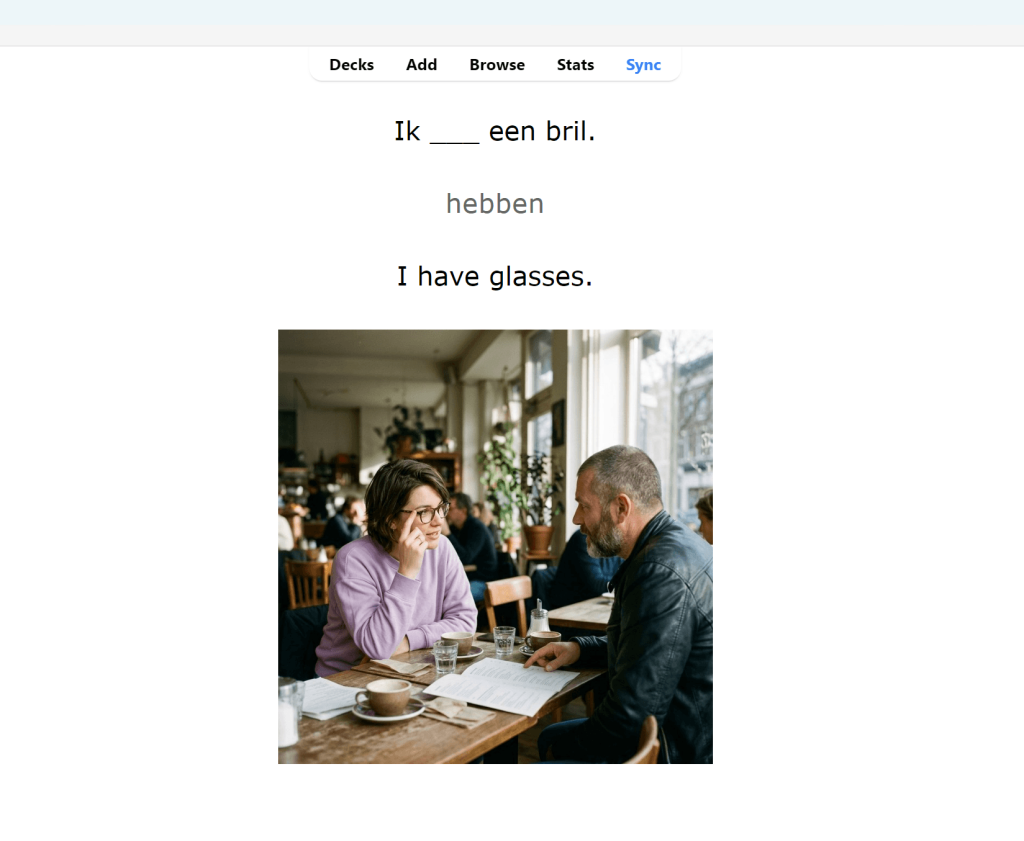
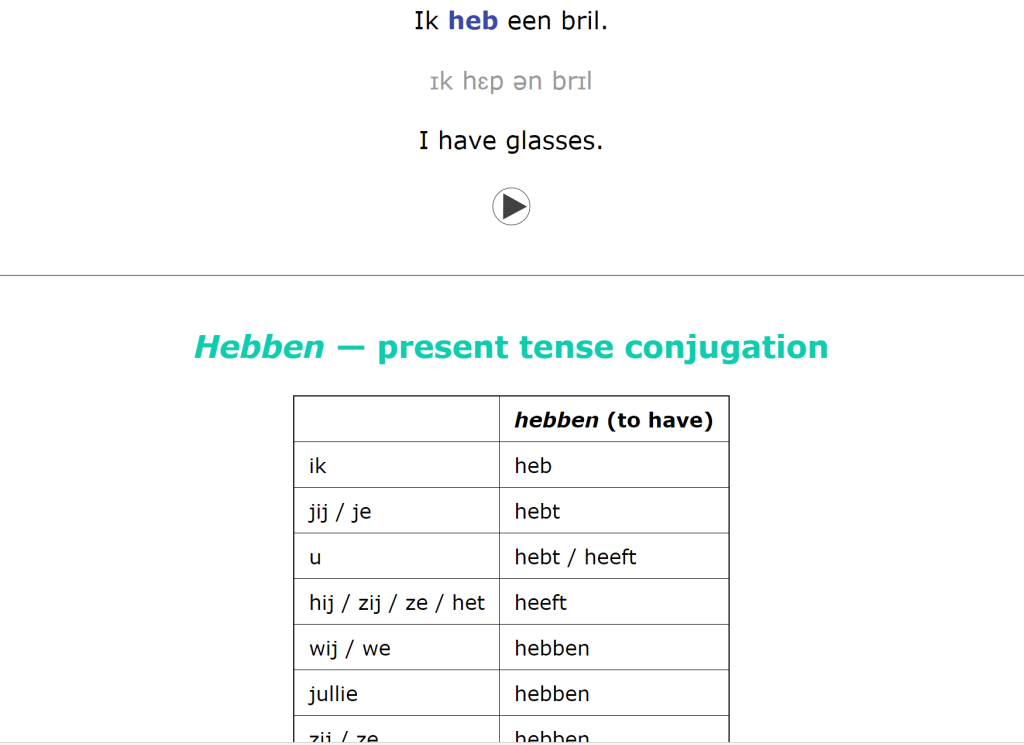
- Type the correct Dutch word
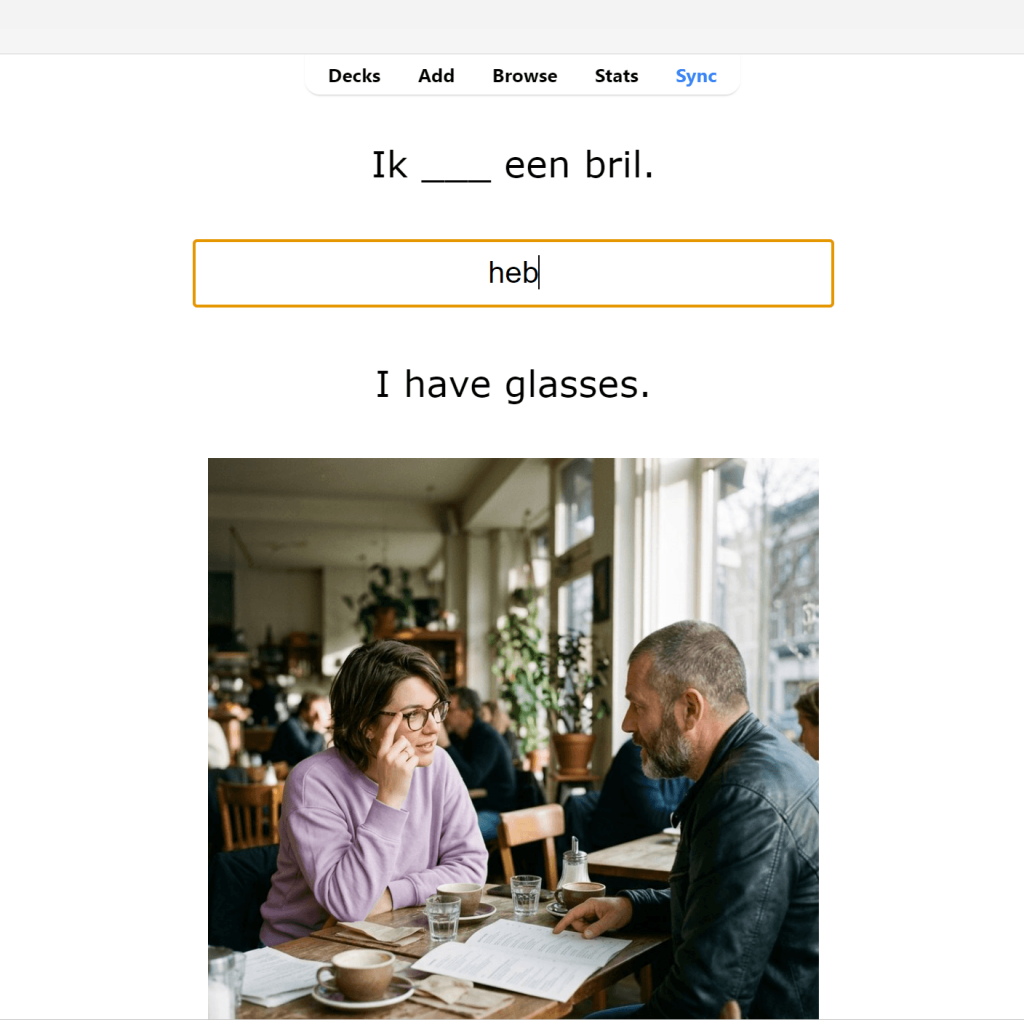
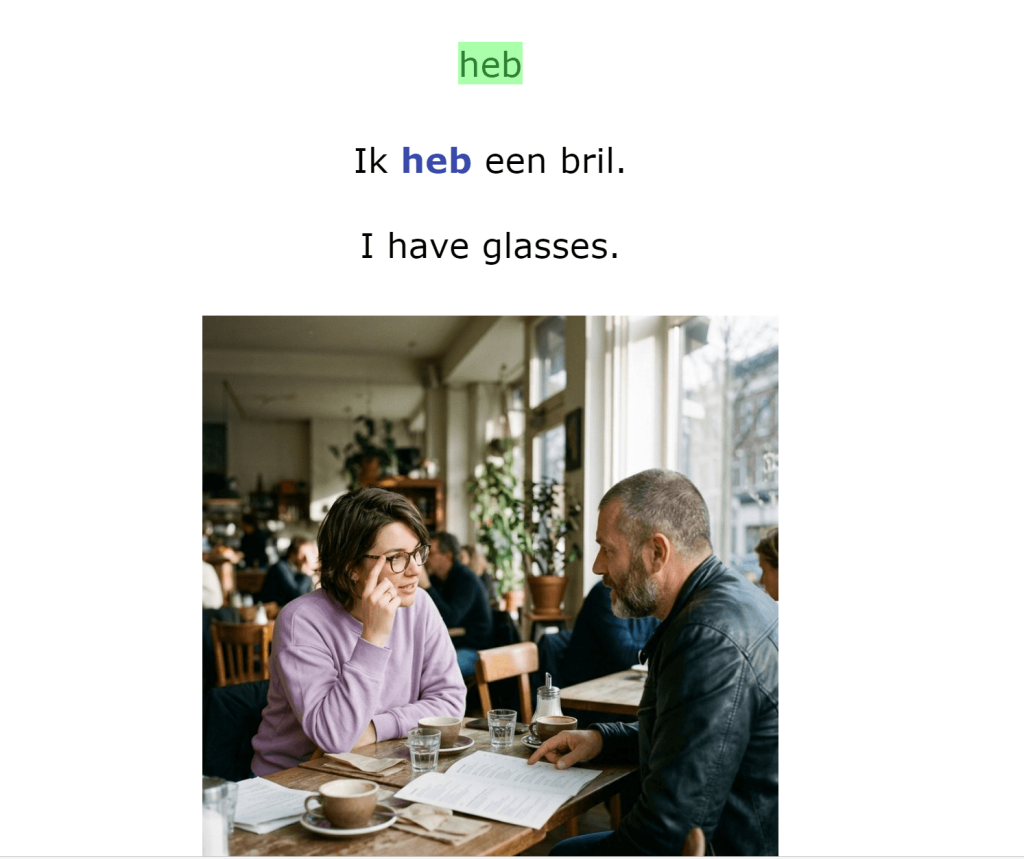
This is the same as the first card, however in this one, you have to type the correct word on the front side. You will see if you were correct, or made any errors on the back side.
Course Content of the Dutch A1 Grammar Anki Deck
The Dutch A1 Grammar Anki Deck contains a total of 1414 Flashcards across 8 chapters, with a total of 114 lessons.
I am going to show you exactly what’s inside the Dutch A1 Grammar Anki Deck, chapter by chapter.
Please note that for every sentence there are 2 card types, so every sentence gives you 2 flashcards.
The card types have been explained in the previous chapter.
Chapter 1: Pronouns
| Lesson | Sentences | Total Flashcards |
| Mijn = My | 4 | 8 |
| Je, Jouw, and Uw = Your | 6 | 12 |
| Zijn and Haar = His and Her | 6 | 12 |
| Ons and Onze = Our | 7 | 14 |
| Jullie = Your [plural & informal] | 4 | 8 |
| Hun = Their | 4 | 8 |
| Deze and Dit = This | 4 | 8 |
| Die and Dat = That | 4 | 8 |
| Deze = These | 4 | 8 |
| Die = Those | 4 | 8 |
| Referring back to a person | 4 | 8 |
| Referring back to a thing | 6 | 12 |
| Me and Mij = Me | 3 | 6 |
| Je, Jou, and U = You | 6 | 12 |
| Hem and Haar = Him and Her | 4 | 8 |
| Ons = Us | 4 | 8 |
| Jullie = You [plural & informal] | 4 | 8 |
| Ze = Them | 4 | 8 |
| How to show ownership with a name in Dutch | 4 | 8 |
| How to show ownership in Dutch | 8 | 16 |
| Van wie? = Whose? | 4 | 8 |
| Total | 196 |
This chapter contains 21 lessons with a total of 196 Flashcards.
You will learn the Dutch words for my, your, and their, for this and that, and for me, you, and them. You will also learn how to show who something belongs to with van.
Chapter 2: Verbs
| Lesson | Sentences | Total Flashcards |
| Finding the verb stem | 4 | 8 |
| Forming the present tense | 13 | 26 |
| Maken, wonen, zetten, and stoppen — present tense conjugation | 12 | 24 |
| Leven, geven, and schrijven — present tense conjugation | 9 | 18 |
| Reizen, lezen, and verhuizen — present tense conjugation | 9 | 18 |
| Stems ending in t: present tense | 3 | 6 |
| Stems ending in d: present tense | 6 | 12 |
| Gaan — present tense conjugation | 7 | 14 |
| Doen — present tense conjugation | 7 | 14 |
| Staan — present tense conjugation | 7 | 14 |
| Zien — present tense conjugation | 7 | 14 |
| Worden — present tense conjugation | 7 | 14 |
| Blijven — present tense conjugation | 7 | 14 |
| Kennen and Weten = To know | 8 | 16 |
| Kunnen — present tense conjugation | 7 | 14 |
| Willen — present tense conjugation | 7 | 14 |
| Moeten — present tense conjugation | 7 | 14 |
| Mogen — present tense conjugation | 7 | 14 |
| Modal verbs with a full verb | 7 | 14 |
| When to use the present tense | 12 | 24 |
| Saying that you are going to do something | 8 | 16 |
| Future plans in the present tense | 7 | 14 |
| Separable verbs | 7 | 14 |
| Separable verbs with wij, jullie, and zij | 6 | 12 |
| Forming commands | 6 | 12 |
| Forming negative commands | 6 | 12 |
| Use the stem with je or jij after the verb | 4 | 8 |
| Je = You or Your | 5 | 10 |
| Questions with kunnen and willen | 4 | 8 |
| Starting a statement with a time or place | 7 | 14 |
| Me = Myself | 4 | 8 |
| Je and Zich = Yourself, Himself, and Herself | 6 | 12 |
| Ons = Ourselves | 3 | 6 |
| Je = Yourselves | 3 | 6 |
| Zich and U = Themselves and Yourself | 3 | 6 |
| Zich vergissen = To be mistaken | 7 | 14 |
| Zich schamen = To feel ashamed | 7 | 14 |
| Total | 492 |
This chapter contains 37 lessons with a total of 492 Flashcards.
You will learn how to form the present tense of regular verbs and of common verbs such as gaan, kunnen, and willen. You will also learn how to use separable verbs, give commands, get the word order right, and use reflexive verbs.
Chapter 3: Articles and Nouns
| Lesson | Sentences | Total Flashcards |
| Een, de, or het | 8 | 16 |
| No article with professions | 3 | 6 |
| De or het from the ending | 10 | 20 |
| Compound nouns | 6 | 12 |
| Plurals with ‘s | 6 | 12 |
| Plural of raam and boom | 4 | 8 |
| Plural of man and bed | 4 | 8 |
| Plural of brief, druif, and duif | 6 | 12 |
| Plural of huis, reis, and prijs | 6 | 12 |
| How to use numbers in Dutch | 17 | 34 |
| How to use ordinal numbers in Dutch | 8 | 16 |
| How to talk about amounts in Dutch | 6 | 12 |
| Een paar = A pair or A few | 4 | 8 |
| Total | 176 |
This chapter contains 13 lessons with a total of 176 Flashcards.
You will learn when to use een, de, or het, how to make nouns plural, and how Dutch builds compound nouns. You will also learn how to use numbers and talk about amounts.
Chapter 4: Adjectives and Adverbs
| Lesson | Sentences | Total Flashcards |
| An adjective before a noun | 6 | 12 |
| No -e with een and a singular het-word | 3 | 6 |
| Add -e after words like mijn and dit | 10 | 20 |
| Adding -e: groot and rood | 4 | 8 |
| Adding -e: wit and dik | 4 | 8 |
| Adding -e: lief and braaf | 4 | 8 |
| Adding -e: grijs and vies | 4 | 8 |
| How to use adverbs in Dutch | 6 | 12 |
| Saying how often something happens | 6 | 12 |
| Heel, Nogal, Te, and Genoeg = Very, Rather, Too, and Enough | 7 | 14 |
| Saying what you like and prefer | 7 | 14 |
| Order of time and place | 5 | 10 |
| Referring back to a place | 7 | 14 |
| Total | 146 |
This chapter contains 13 lessons with a total of 146 Flashcards.
You will learn when an adjective gets an -e and how its spelling changes. You will also learn how to use adverbs, say how often something happens, and put time and place in the right order.
Chapter 5: Questions and Interrogatives
| Lesson | Sentences | Total Flashcards |
| Yes/no questions | 6 | 12 |
| Question words: wie, wat, waar, and more | 8 | 16 |
| Asking who or what does something | 9 | 18 |
| Welk or welke | 6 | 12 |
| Asking how much or how many | 4 | 8 |
| Asking how long, how big, how far, and how often | 4 | 8 |
| Total | 74 |
This chapter contains 6 lessons with a total of 74 Flashcards.
You will learn how to ask yes/no questions and how to use question words such as wie, wat, waar, and welk. You will also learn how to ask how much, how many, how long, and how often.
Chapter 6: Negations
| Lesson | Sentences | Total Flashcards |
| Use geen to say “no” or “not a” | 6 | 12 |
| Niet with actions and descriptions | 4 | 8 |
| Niet after a noun with de or het | 4 | 8 |
| Ni |