
Do you want to know how to learn Dutch B2 in the most effective and efficient way possible?
If so, the Dutch B2 Grammar Anki Deck is the best solution for you!
In this post I am going to explain everything you need to know about why you should use the Dutch B2 Grammar Anki Deck, what it is, and how to get it!
Why should you use this Dutch B2 Grammar Anki Deck?
Additionally, for further clarity, the International Phonetic Alphabet (IPA) is provided for every sentence. This means that you can check pronunciation whenever needed.
One of the biggest advantages of using the Dutch B2 Grammar Anki Deck, is that it is the PERFECT tool for memorizing what you have learned. No longer will you keep forgetting what you studied!
Read more on the benefits of Anki in the next chapter!
Why is it so important to use Anki?

Card Structure of the Dutch B2 Grammar Anki Deck
Every grammar point in the Dutch B2 Grammar Anki Deck is practised in full sentences, so you learn it in context. Each sentence card includes an image, IPA notation, an explanation, and an audio file.
The image allows you to create a better memory with the word/concept that you are studying. You are linking a concept with a certain image.
The IPA notation shows you exactly how the sentence is pronounced, so you can repeat that pronunciation yourself.
The explanation is there so you always understand why the answer is correct, even if you have forgotten the rule.
The audio file allows you to understand how something is pronounced in Dutch. This will help you to improve your Dutch comprehension.
Here is an extract, so you can hear what the audio sounds like in the Dutch B2 Grammar Anki Deck.
There are 2 card types in the Dutch B2 Grammar Anki Deck.
- Fill in the blank
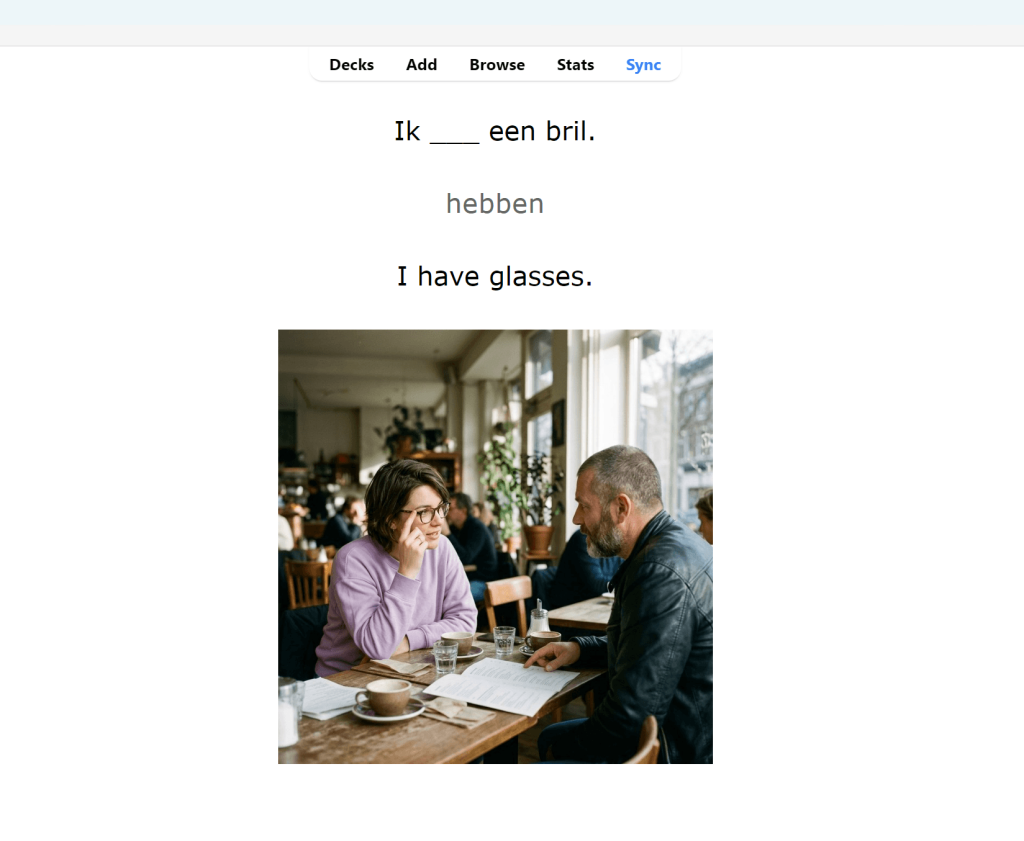
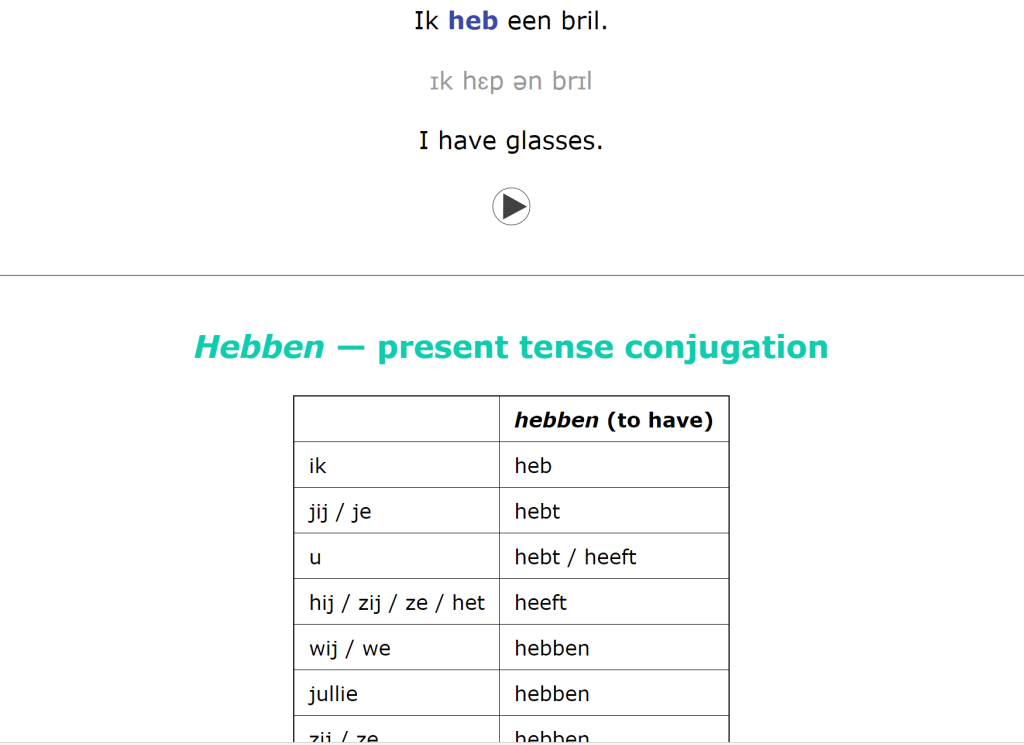
- Type the correct Dutch word
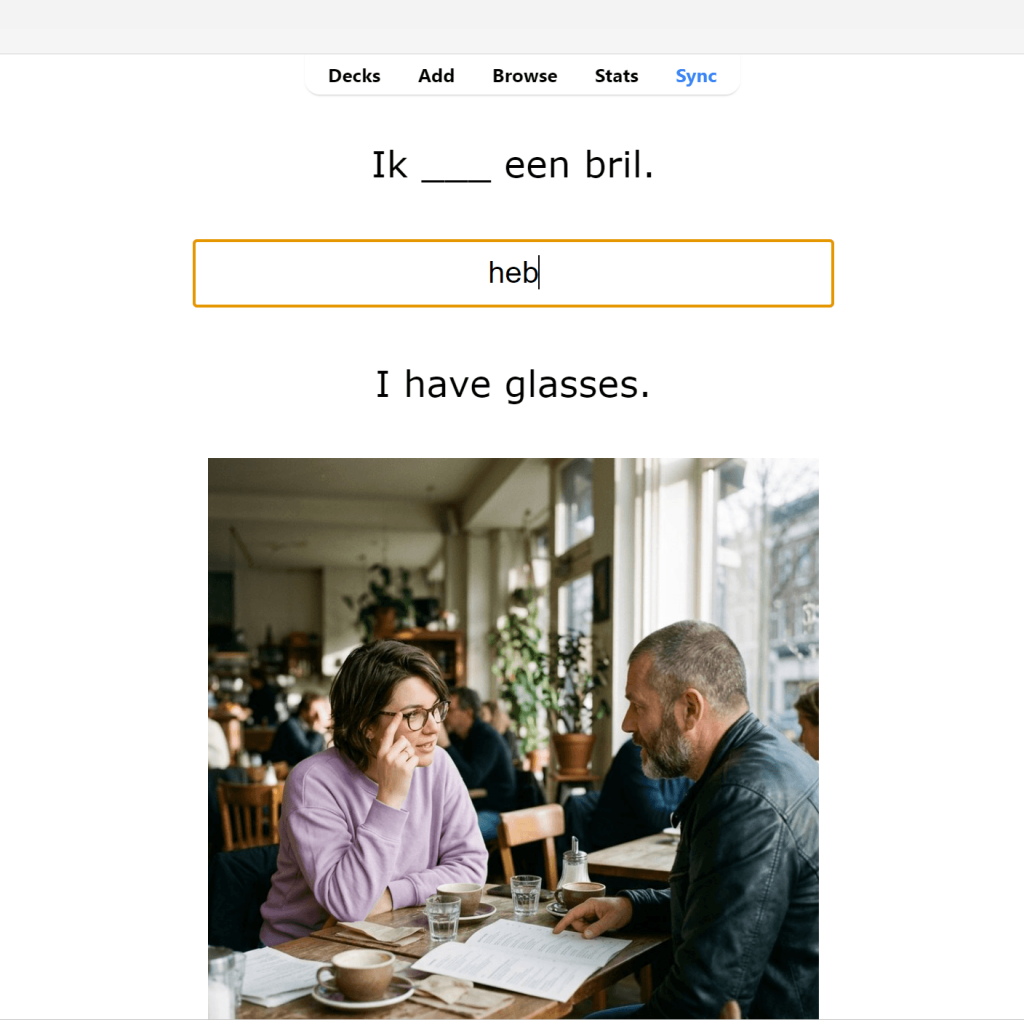
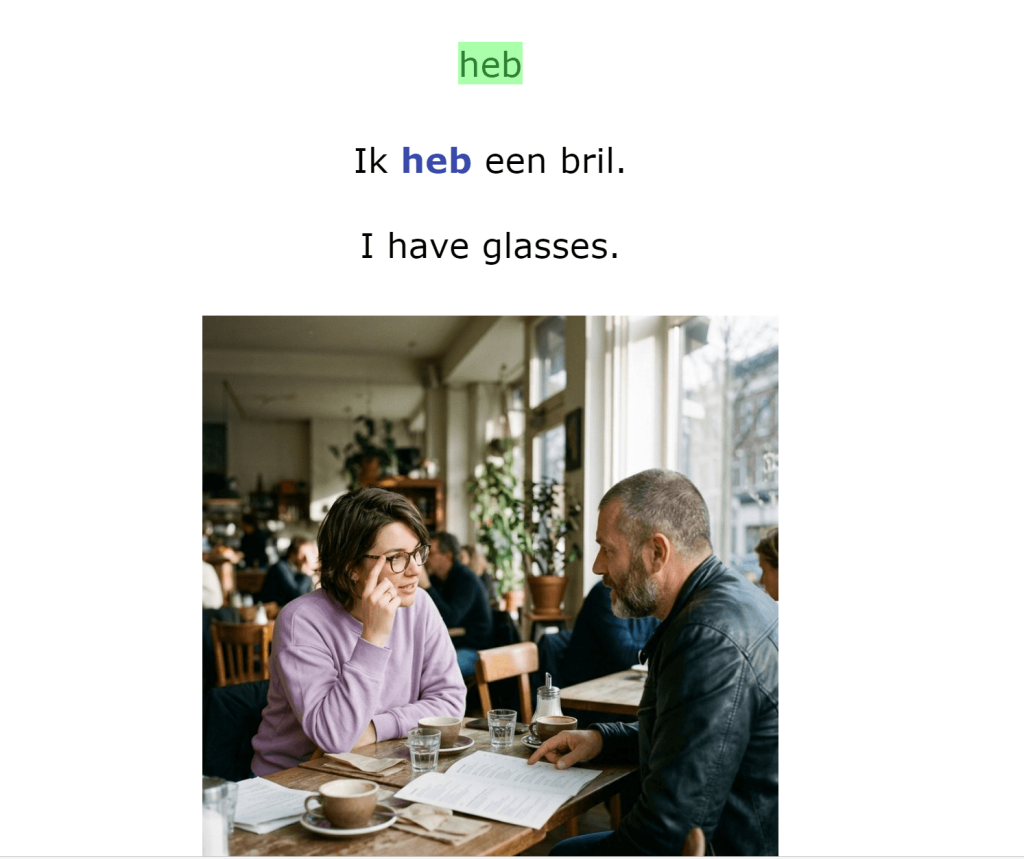
This is the same as the first card, however in this one, you have to type the correct word on the front side. You will see if you were correct, or made any errors on the back side.
Course Content of the Dutch B2 Grammar Anki Deck
The Dutch B2 Grammar Anki Deck contains a total of 840 Flashcards across 8 chapters, with a total of 80 lessons.
I am going to show you exactly what’s inside the Dutch B2 Grammar Anki Deck, chapter by chapter.
Please note that for every sentence there are 2 card types, so every sentence gives you 2 flashcards.
The card types have been explained in the previous chapter.
Chapter 1: Pronouns
| Lesson | Sentences | Total Flashcards |
| Beide and Allebei = Both | 6 | 12 |
| Sommige and Enkele = Some and A Few | 6 | 12 |
| Zo’n, Zulke, and Zulk = Such a and Such | 8 | 16 |
| Dezelfde and Hetzelfde = The Same | 7 | 14 |
| Mezelf, jezelf, and more after a preposition | 8 | 16 |
| Zich versus Zichzelf | 6 | 12 |
| Elkaar versus Zichzelf | 6 | 12 |
| Die and dat to refer back | 8 | 16 |
| Ze for people in general | 6 | 12 |
| Hierover and Hiermee = About This and With This | 4 | 8 |
| Ergens = Somewhere or Something | 6 | 12 |
| Nergens = Nowhere or Nothing | 6 | 12 |
| Overal = Everywhere or Everything | 6 | 12 |
| Zorg ervoor dat, Denk eraan dat, and Ik reken erop dat | 6 | 12 |
| Ik denk erover om … te and Ik kies ervoor om … te | 4 | 8 |
| Saying how many things there are | 5 | 10 |
| Het beste wat and Het enige wat | 4 | 8 |
| Splitting waarmee, waarover, waarop, and waaraan | 4 | 8 |
| Total | 212 |
This chapter contains 18 lessons with a total of 212 Flashcards.
You will learn words such as beide, allebei, sommige, zo’n, and dezelfde, and the difference between zich, zichzelf, and elkaar. You will also learn how to use ergens, nergens, and overal, and fixed expressions with er such as zorg ervoor dat.
Chapter 2: Verbs
| Lesson | Sentences | Total Flashcards |
| Had moeten = Should have | 6 | 12 |
| Heb moeten versus Had moeten | 6 | 12 |
| Had kunnen = Could have | 4 | 8 |
| Had moeten after dat | 6 | 12 |
| Zien and horen in the present perfect | 8 | 16 |
| Laten in the present perfect | 6 | 12 |
| Zitten, staan, and liggen in the present perfect | 6 | 12 |
| Blijven in the present perfect | 6 | 12 |
| Had niet hoeven = Did not need to | 4 | 8 |
| Vóórkomen versus Voorkómen | 6 | 12 |
| When om does not mean “in order to” | 5 | 10 |
| Passive in the past perfect | 5 | 10 |
| Passive in the future | 5 | 10 |
| Passive with moeten | 5 | 10 |
| Passive with kunnen | 5 | 10 |
| Passive in the present perfect after dat | 6 | 12 |
| Guesses about the past | 5 | 10 |
| Use moeten to say “must have” | 5 | 10 |
| Use kunnen to say “may have” | 5 | 10 |
| The tense after zei dat | 6 | 12 |
| Reporting a plan or a promise | 5 | 10 |
| Zou = Is said to | 5 | 10 |
| Reflexive verbs with a fixed preposition | 8 | 16 |
| More verbs with a fixed preposition | 6 | 12 |
| Total | 268 |
This chapter contains 24 lessons with a total of 268 Flashcards.
You will learn how to say should have and could have with had moeten and had kunnen, and how to use modal verbs to make guesses about the past. You will also learn the passive in more tenses and with modal verbs, how to report plans and promises, and more verbs with fixed prepositions.
Chapter 3: Articles and Nouns
| Lesson | Sentences | Total Flashcards |
| Articles with places | 8 | 16 |
| How to use group words in Dutch | 5 | 10 |
| Total | 26 |
This chapter contains 2 lessons with a total of 26 Flashcards.
You will learn when to use an article with places. You will also learn how to use group words in Dutch.
Chapter 4: Adjectives and Adverbs
| Lesson | Sentences | Total Flashcards |
| Use on- to say the opposite | 5 | 10 |
| Saying what something is made of | 4 | 8 |
| Zo … dat = So … that | 4 | 8 |
| Te … om te = Too … to | 4 | 8 |
| Genoeg om te = Enough to | 4 | 8 |
| Maar = But or Only | 6 | 12 |
| Eigenlijk = Actually | 3 | 6 |
| Blijkbaar = Apparently | 3 | 6 |
| Bovendien = Moreover | 3 | 6 |
| Anders = Otherwise | 3 | 6 |
| Daardoor = Because of that | 3 | 6 |
| Total | 84 |
This chapter contains 11 lessons with a total of 84 Flashcards.
You will learn how to use on- to say the opposite, and how to say what something is made of. You will also learn constructions such as zo … dat and te … om te, and linking words such as eigenlijk, bovendien, anders, and daardoor.
Chapter 5: Questions and Interrogatives
| Lesson | Sentences | Total Flashcards |
| Nou: a question that is not a real question | 3 | 6 |
| Total | 6 |
This chapter contains 1 lesson with a total of 6 Flashcards.
You will learn how to use nou in questions that are not real questions.
Chapter 6: Negations
| Lesson | Sentences | Total Flashcards |
| Niet eens = Not even | 3 | 6 |
| Geen enkele and Geen enkel = Not a Single | 6 | 12 |
| Bijna niet and Nauwelijks = Hardly | 8 | 16 |
| Total | 34 |
This chapter contains 3 lessons with a total of 34 Flashcards.
You will learn how to say not even, not a single, and hardly in Dutch.
Chapter 7: Prepositions and Conjunctions
| Lesson | Sentences | Total Flashcards |
| Tenzij = Unless | 6 | 12 |
| Mits = Provided that | 6 | 12 |
| Zolang = As long as (for a condition) | 6 | 12 |
| Voor zover = As far as | 6 | 12 |
| Aangezien = Since (for a reason) | 6 | 12 |
| Nu = Now that | 6 | 12 |
| Ook al = Even though | 9 | 18 |
| Zelfs als = Even if | 6 | 12 |
| Hoe … ook = No matter how | 6 | 12 |
| Wat … ook = Whatever | 6 | 12 |
| Wie … ook = Whoever | 6 | 12 |
| Zoals = As (as you know) | 6 | 12 |
| Naarmate = As (for a gradual change) | 6 | 12 |
| Enerzijds …, anderzijds … = On the one hand …, on the other hand … | 3 | 6 |
| In verband met = Due to | 3 | 6 |
| Total | 174 |
This chapter contains 15 lessons with a total of 174 Flashcards.
You will learn conjunctions for conditions and contrasts, such as tenzij, mits, aangezien, ook al, and zelfs als. You will also