
Do you want to know how to learn Dutch B1 in the most effective and efficient way possible?
If so, the Dutch B1 Grammar Anki Deck is the best solution for you!
In this post I am going to explain everything you need to know about why you should use the Dutch B1 Grammar Anki Deck, what it is, and how to get it!
Why should you use this Dutch B1 Grammar Anki Deck?
Additionally, for further clarity, the International Phonetic Alphabet (IPA) is provided for every sentence. This means that you can check pronunciation whenever needed.
One of the biggest advantages of using the Dutch B1 Grammar Anki Deck, is that it is the PERFECT tool for memorizing what you have learned. No longer will you keep forgetting what you studied!
Read more on the benefits of Anki in the next chapter!
Why is it so important to use Anki?

Card Structure of the Dutch B1 Grammar Anki Deck
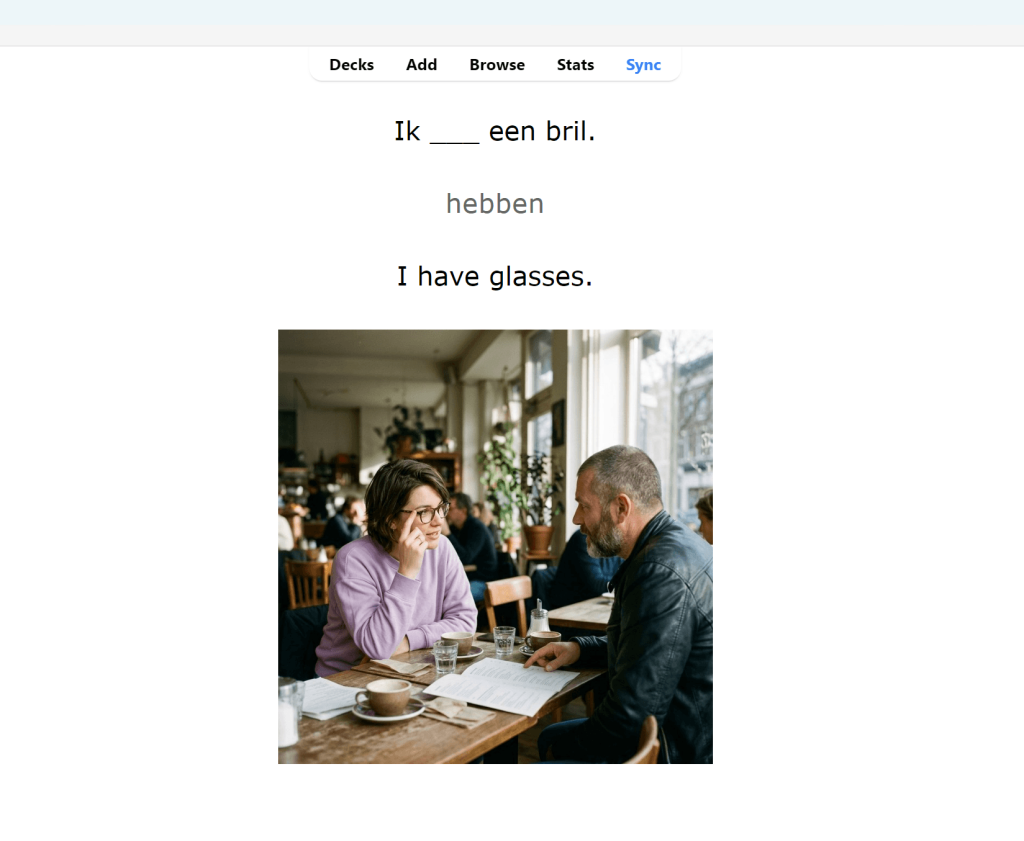
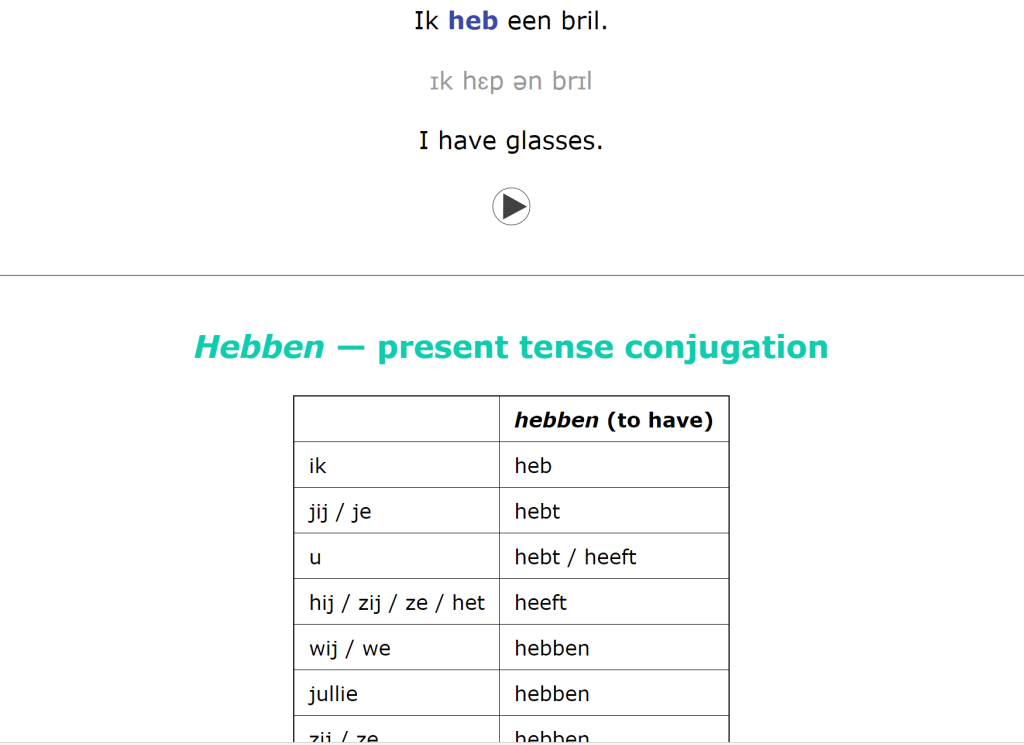
Every grammar point in the Dutch B1 Grammar Anki Deck is practised in full sentences, so you learn it in context. Each sentence card includes an image, IPA notation, an explanation, and an audio file.
The image allows you to create a better memory with the word/concept that you are studying. You are linking a concept with a certain image.
The IPA notation shows you exactly how the sentence is pronounced, so you can repeat that pronunciation yourself.
The explanation is there so you always understand why the answer is correct, even if you have forgotten the rule.
The audio file allows you to understand how something is pronounced in Dutch. This will help you to improve your Dutch comprehension.
Here is an extract, so you can hear what the audio sounds like in the Dutch B1 Grammar Anki Deck.
There are 2 card types in the Dutch B1 Grammar Anki Deck.
- Fill in the blank
- Type the correct Dutch word
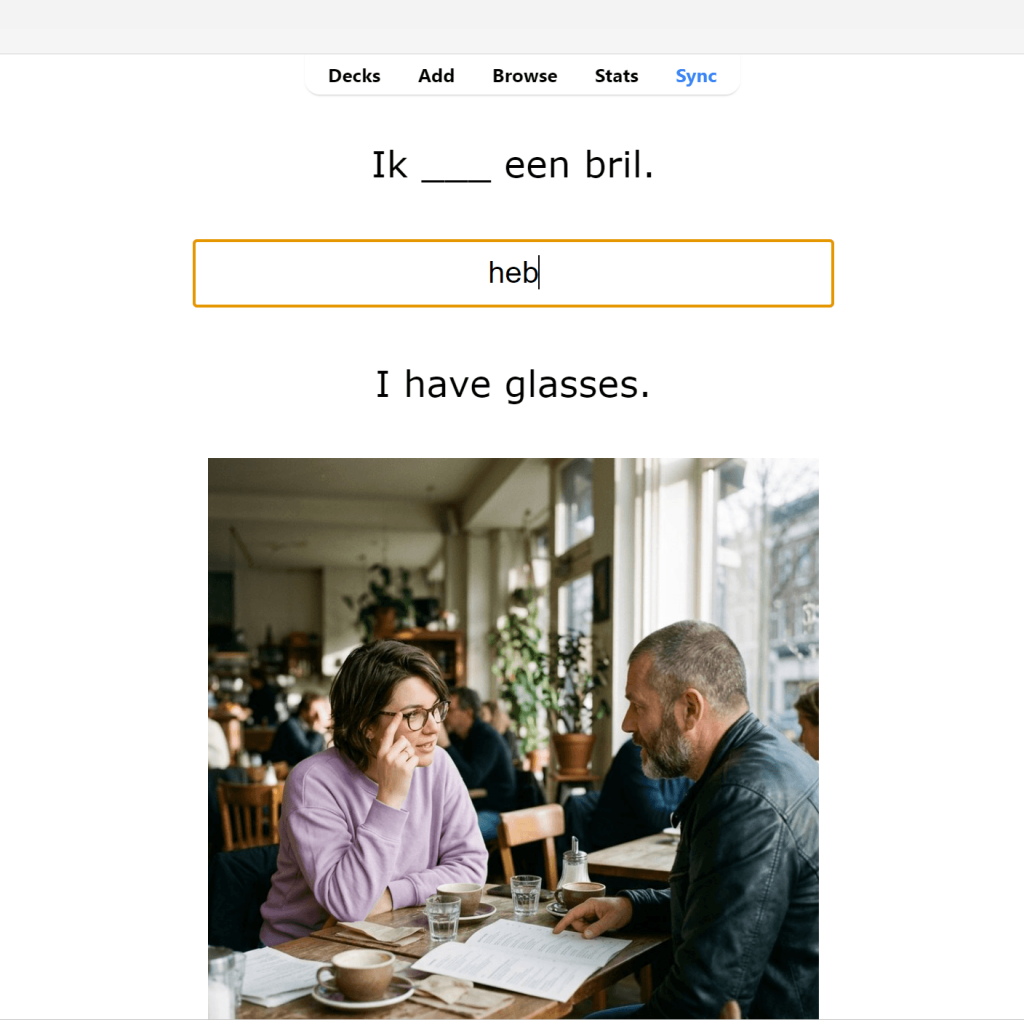
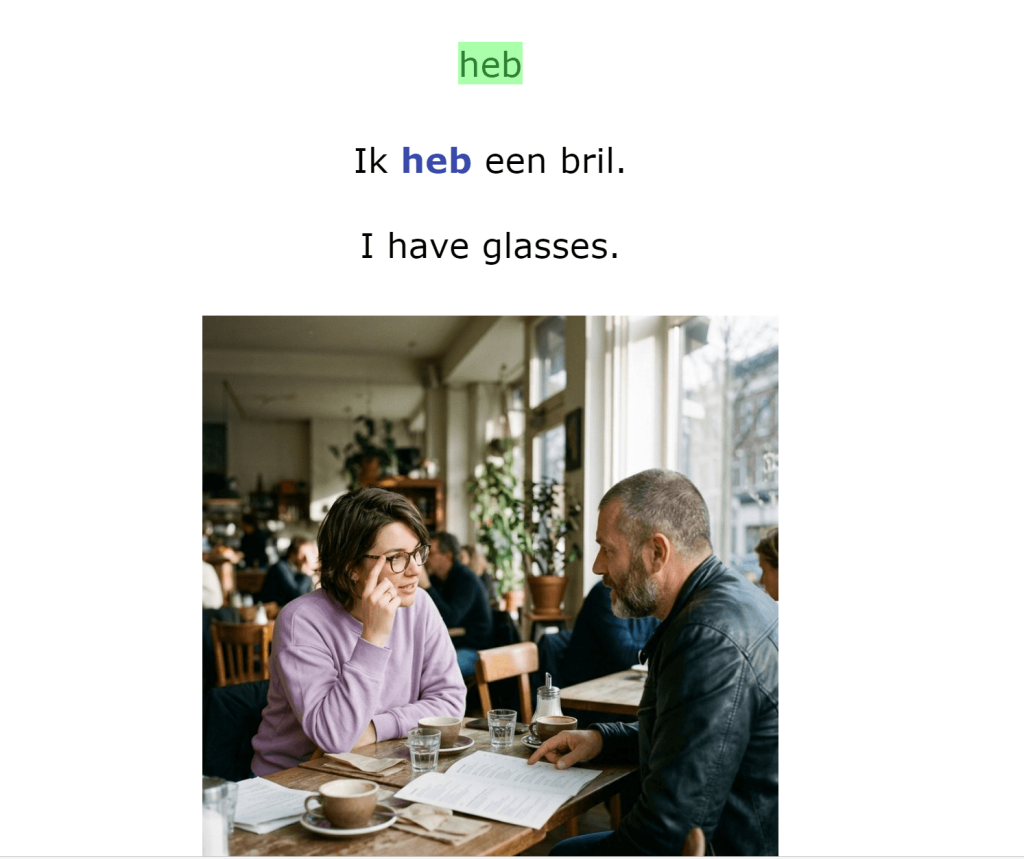
This is the same as the first card, however in this one, you have to type the correct word on the front side. You will see if you were correct, or made any errors on the back side.
Course Content of the Dutch B1 Grammar Anki Deck
The Dutch B1 Grammar Anki Deck contains a total of 1604 Flashcards across 8 chapters, with a total of 146 lessons.
I am going to show you exactly what’s inside the Dutch B1 Grammar Anki Deck, chapter by chapter.
Please note that for every sentence there are 2 card types, so every sentence gives you 2 flashcards.
The card types have been explained in the previous chapter.
Chapter 1: Pronouns
| Lesson | Sentences | Total Flashcards |
| Elke and Elk = Every | 4 | 8 |
| Die van mij and Dat van mij = Mine | 6 | 12 |
| Die van jou, u, hem, and haar = Yours, His, and Hers | 8 | 16 |
| Die van ons, jullie, and hen = Ours, Yours, and Theirs | 6 | 12 |
| Use zelf to say “without help” or “in person” | 7 | 14 |
| Giving or sending it to someone | 4 | 8 |
| Hen versus Hun | 10 | 20 |
| Er veel, Er genoeg, and Er meer = A lot, Enough, and More | 6 | 12 |
| Erop, Eraan, Erover, and Ervoor | 8 | 16 |
| Ermee = With it | 3 | 6 |
| Splitting er and the preposition | 5 | 10 |
| Daarover and Daarmee = About That and With That | 4 | 8 |
| Hem, haar, and hen after a preposition | 12 | 24 |
| Wat after alles, iets, and niets | 6 | 12 |
| Wat after a whole sentence | 4 | 8 |
| Degene die = The one who | 4 | 8 |
| Wie = Whoever | 4 | 8 |
| Met wie, Voor wie, and Aan wie = With whom, For whom, and To whom | 6 | 12 |
| Waar after a place | 4 | 8 |
| Waarmee and Waarover = With which and About which | 4 | 8 |
| Total | 230 |
This chapter contains 20 lessons with a total of 230 Flashcards.
You will learn how to say mine, yours, and theirs, how to use er with prepositions, and the difference between hen and hun. You will also learn relative pronouns such as wat, wie, degene die, waar, and waarmee.
Chapter 2: Verbs
| Lesson | Sentences | Total Flashcards |
| When to use the past perfect | 1 | 2 |
| Forming the past perfect | 4 | 8 |
| Past perfect with hebben | 8 | 16 |
| Past perfect with zijn | 8 | 16 |
| Reporting what someone said | 6 | 12 |
| Present perfect with a modal verb | 6 | 12 |
| Present perfect with a modal verb after dat | 6 | 12 |
| Separable verbs in the present perfect with a modal verb | 6 | 12 |
| Saying that someone keeps doing something | 6 | 12 |
| Doorgaan met = To continue | 6 | 12 |
| Zitten, staan, liggen, and lopen with te | 8 | 16 |
| Zitten, staan, liggen, and lopen with te in the past | 8 | 16 |
| Saying what you see or hear someone do | 6 | 12 |
| Laten = To let | 6 | 12 |
| Laten = To have something done | 6 | 12 |
| Zal wel = Probably | 6 | 12 |
| Use moeten to say “must be” | 6 | 12 |
| Use kunnen to say “could be” | 6 | 12 |
| Lijken = To seem | 6 | 12 |
| Blijken = To turn out | 6 | 12 |
| Schijnen = Apparently | 6 | 12 |
| Zou = Would | 7 | 14 |
| Conditional sentences | 8 | 16 |
| Conditional sentences about the past | 8 | 16 |
| Rijden, begrijpen, lijken, and verdwijnen in the past | 12 | 24 |
| Kiezen, verliezen, vliegen, and sluiten in the past | 12 | 24 |
| Winnen, zwemmen, trekken, and vertrekken in the past | 12 | 24 |
| Breken, stelen, dragen, and slaan in the past | 12 | 24 |
| Houden, roepen, hangen, and vangen in the past | 12 | 24 |
| Bakken, wassen, and lachen in the past | 9 | 18 |
| Passive in the simple past | 6 | 12 |
| Passive in the present perfect | 6 | 12 |
| Describe a past activity without naming who | 8 | 16 |
| Total | 478 |
This chapter contains 33 lessons with a total of 478 Flashcards.
You will learn how to form and use the past perfect, the present perfect with a modal verb, and the passive in the past. You will also learn how to report what someone said, how to use laten, lijken, blijken, and schijnen, and how to form conditional sentences with zou.
Chapter 3: Articles and Nouns
| Lesson | Sentences | Total Flashcards |
| Spelling the middle of a compound noun | 7 | 14 |
| When to add -s- in the middle of a compound noun | 8 | 16 |
| Plurals of words from Latin | 6 | 12 |
| Time words after a number | 6 | 12 |
| Ordering drinks | 4 | 8 |
| Kinds of food and drink | 8 | 16 |
| A verb as a noun | 5 | 10 |
| An adjective for a person | 7 | 14 |
| Het leuke is = The nice thing is | 6 | 12 |
| Total | 114 |
This chapter contains 9 lessons with a total of 114 Flashcards.
You will learn how to spell compound nouns and when to add -s- in the middle. You will also learn plurals of words from Latin, how to order drinks, and how to use a verb or an adjective as a noun.
Chapter 4: Adjectives and Adverbs
| Lesson | Sentences | Total Flashcards |
| An adjective after iets, niets, veel, and weinig | 8 | 16 |
| A past participle as an adjective | 6 | 12 |
| The present participle | 6 | 12 |
| A present participle as an adjective | 8 | 16 |
| Present participle versus Past participle | 6 | 12 |
| Adjectives with fixed prepositions | 7 | 14 |
| Saying that something keeps changing | 10 | 20 |
| Hoe meer …, hoe beter … = The more …, the better … | 4 | 8 |
| A pronoun goes before a time word | 5 | 10 |
| Al = Already or Yet | 6 | 12 |
| Nog = Still | 6 | 12 |
| Nog = More | 6 | 12 |
| Pas = Not until or Only | 6 | 12 |
| Al versus Pas | 6 | 12 |
| Where to put ook | 6 | 12 |
| Where to put alleen | 6 | 12 |
| Where to put zelfs | 6 | 12 |
| Toch = Anyway or Still | 4 | 8 |
| Echter = However | 4 | 8 |
| Daarentegen = On the other hand | 4 | 8 |
| Even: making a request softer | 4 | 8 |
| Eens: inviting someone to try or look | 4 | 8 |
| Maar: giving permission or encouraging | 4 | 8 |
| Toch: reminding someone | 4 | 8 |
| Total | 272 |
This chapter contains 24 lessons with a total of 272 Flashcards.
You will learn how to use participles as adjectives and how to say the more …, the better …. You will also learn small but important words such as al, nog, pas, toch, even, eens, and maar, and where to put ook, alleen, and zelfs.
Chapter 5: Questions and Interrogatives
| Lesson | Sentences | Total Flashcards |
| Waar: asking about things | 4 | 8 |
| Weet jij waar: asking about things | 6 | 12 |
| Polite questions | 5 | 10 |
| Ik vraag me af = I wonder | 6 | 12 |
| Hoe komt het dat …? = How come …? | 4 | 8 |
| Hè? = Right? | 3 | 6 |
| Toch? = Right? | 3 | 6 |
| Hè versus Toch | 3 | 6 |
| Zeker = I suppose | 3 | 6 |
| Questions with niet or geen | 4 | 8 |
| Answering a question with niet or geen | 6 | 12 |
| Checking what someone said | 6 | 12 |
| Asking what or who someone means | 6 | 12 |