
Why should you use the Japanese B2 Vocabulary Anki Deck?
Additionally, for further clarity, the International Phonetic Alphabet (IPA) is provided for all words and sentences. This means that you can check pronunciation whenever needed.
One of the biggest advantages of using the Japanese B2 Vocabulary Anki Deck, is that it is the PERFECT tool for memorizing what you have learned. No longer will you keep forgetting what you studied!
Read more on the benefits of Anki in the next chapter!
Why is it so important to use Anki?

Card Structure of the Japanese B2 Vocabulary Anki Deck
All words in the Japanese B2 Vocabulary Anki Deck are used in sentences to help you learn them in context. Each flashcard includes furigana, an image, IPA notation, and an audio file.
Furigana is shown above kanji, so you can read the Japanese sentence even when you do not yet know all the kanji.
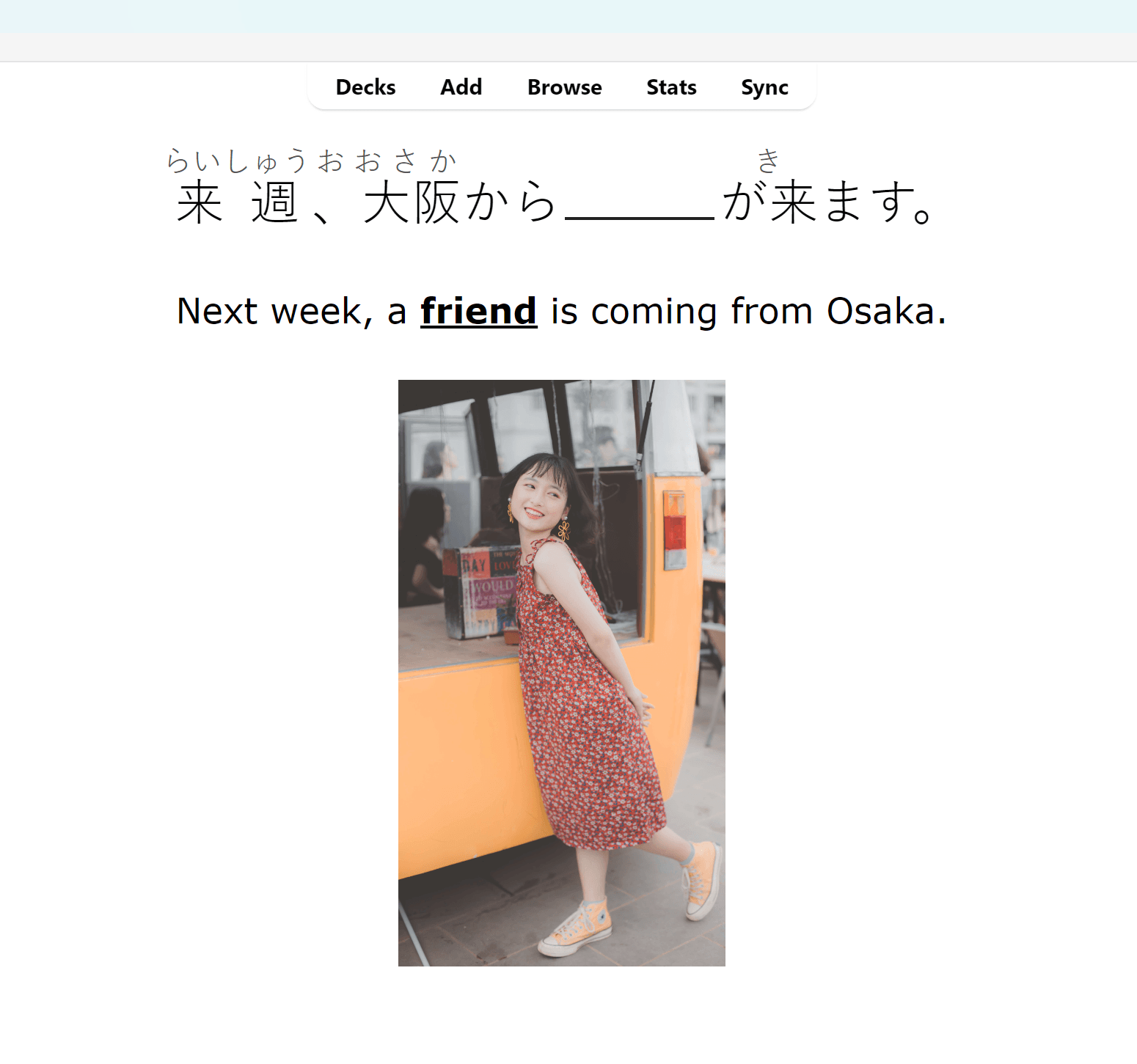
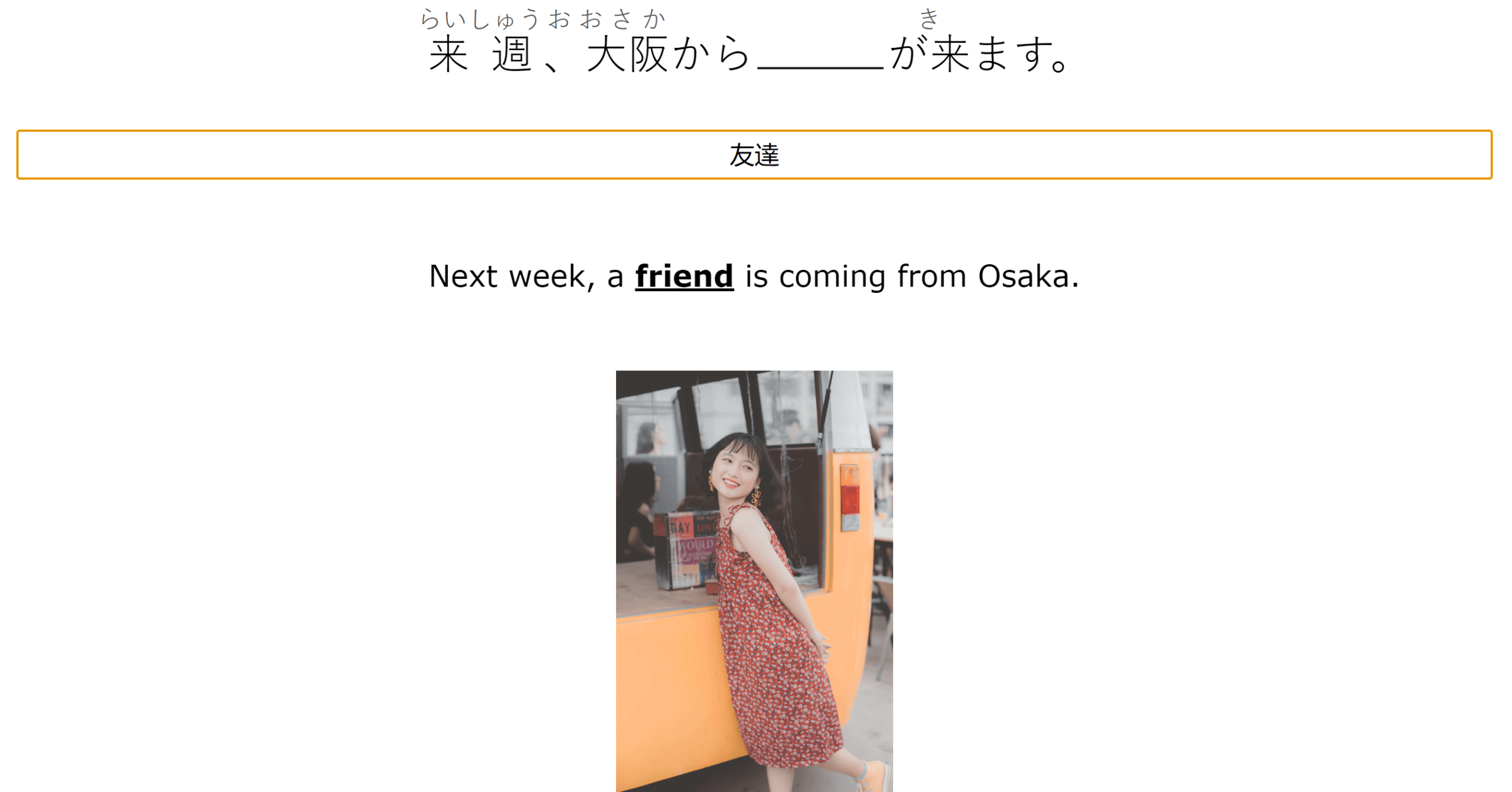
On the front side, you will find a sentence in both Japanese and English. This is accompanied by an image that shows the context of the sentence. In the Japanese sentence, the word you need to know is missing and represented as a blank. In the English sentence, the word you need to know is bolded and underlined. You should determine what belongs in place of the blank.
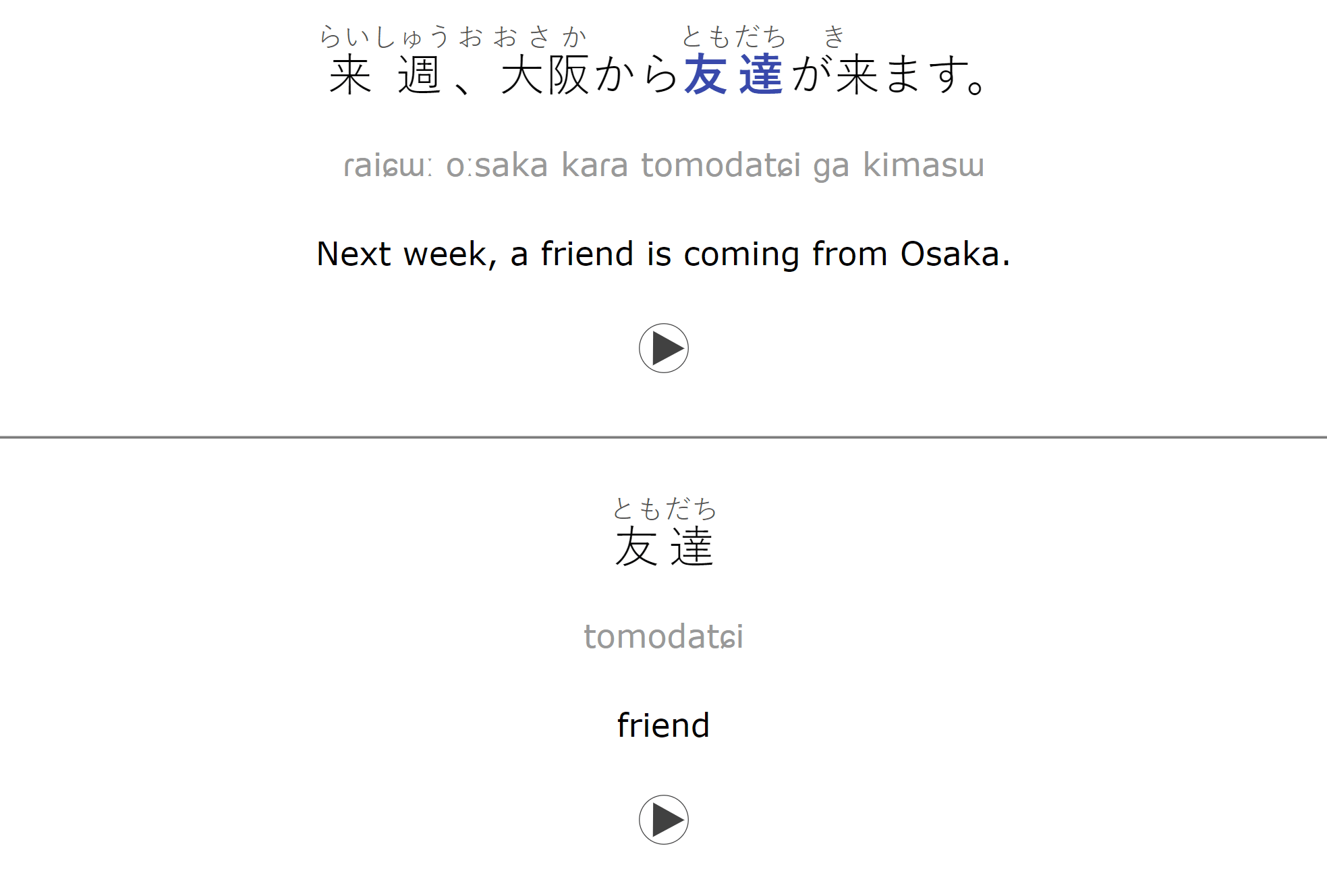
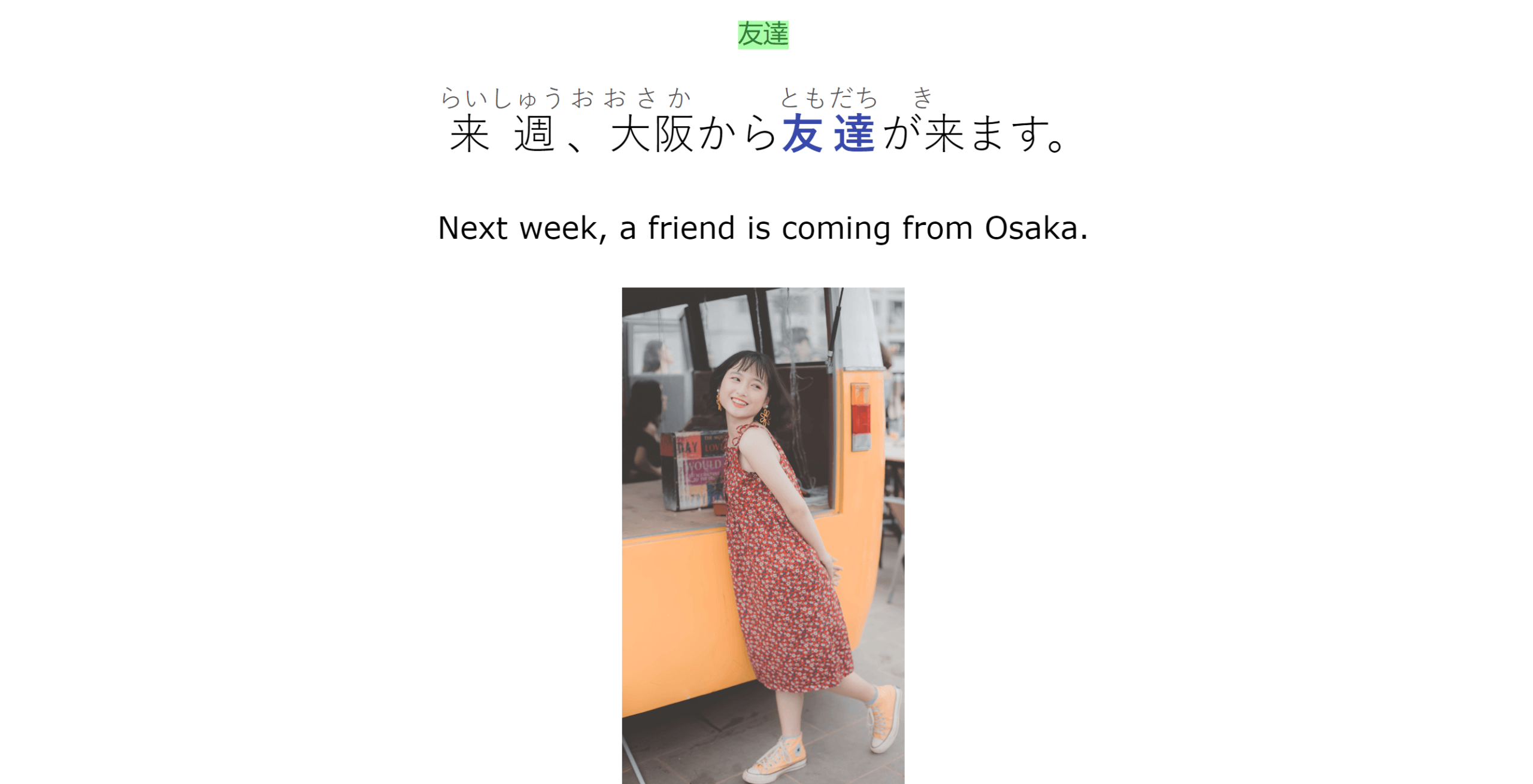
On the back, you will see the full Japanese sentence with the target word highlighted in indigo. This is so you can immediately spot the answer. Below that you will find the IPA transcription of the sentence, the English translation, and an audio file of the sentence.
For verbs, the card shows two forms of the word:
- The polite form (ます form, e.g. 食べます) comes first, as this is the form you will actually use in everyday conversation.
- The dictionary form (e.g. 食べる) comes second, as this is the form used in dictionaries and grammar references.
Each form is accompanied by its IPA transcription, English translation, and audio file, so you can hear exactly how each form sounds.
For nouns, adjectives, adverbs, and other word classes, only one form is shown. These words do not have a separate polite/dictionary distinction the way verbs do.
You will also see just the Japanese word, its IPA transcription, its English translation, and an audio file of the word. This allows you to see and hear the word in a sentence and just by itself.
Course Content of the Japanese B2 Vocabulary Anki Deck
Every chapter has 1 lesson except for the nouns chapter, which contains 19 lessons. These 19 lessons correspond to the 19 categories into which the nouns are divided.
Chapter 1: Pronouns
The first chapter of the Japanese B2 Vocabulary Anki Deck is about subject pronouns!
The chapter has 4 Flashcards.
These are the words that you will be learning:
| whom | whoever |
Chapter 2: Conjunctions
The second chapter of the Japanese B2 Vocabulary Anki Deck is about conjunctions!
The chapter has 10 Flashcards.
These are the words that you will be learning:
| plus | whereas |
| wherever | yet |
| whilst |
Chapter 3: Verbs
The third chapter of the Japanese B2 Vocabulary Anki Deck is about verbs!
The chapter has 726 Flashcards.
These are the words that you will be learning:
| to abandon | to absorb |
| to absorb | to accommodate (provide somebody with a room or place to sleep, live or sit) |
| to accompany | to accomplish |
| to accuse | to acknowledge |
| to acquire | to activate |
| to adapt | to address (give attention to something) |
| to adjust | to adopt |
| to advance (develop) | to aid |
| to alarm | to alter |
| to anticipate | to appeal (make a deeply felt request) |
| to approach | to approve |
| to arise (stand up) | to assess |
| to assign | to associate |
| to assume | to assure |
| to attempt | to back (support) |
| to bar (prevent) | to battle |
| to beg | to bet |
| to bid | to bill |
| to blame | to boost (increase) |
| to border (land area) | the broadcast (programme) |
| to calculate | to cancel |
| to capture | to chain |
| to chair | to challenge |
| to chart (track progress, changes) | to chase |
| to cheer | to chop |
| to cite | to clarify |
| to classify (sort by class or kind) | to collapse |
| to comfort | to command |
| to commission (order or authorize the production of something) | to compose |
| to comprise | to concern |
| to conduct | to confess |
| to conflict | to construct |
| to consult (go to somebody for information or advice) | to contest |
| to contract (get an illness) | to contribute |
| to convert (religion) | to convey |
| the cope | to crack (break) |
| to crash | to credit (with achievement) |
| to criticize | to cure |
| to curve | to dare |
| to date (find age) | to debate |
| to declare | to decline |
| to decrease | to defeat |
| to defend | to delay |
| to delete | to delight |
| to demand | to demonstrate |
| to deny | to depart |
| to derive | to desert |
| to deserve | to desire |
| to detail (give facts/information) | to detect |
| to devote | to differ |
| to dig | to disappoint |
| to discount | to discourage |
| to dismiss | to display |
| to distinguish | to distract |
| to distribute | to disturb |
| to dive | to divorce |
| to document | to dominate |
| to draft (first rough version of something) | to draft (military) |
| to drag | to dump (get rid of something you do not want) |
| to edit | to elect |
| to eliminate | to embrace |
| to emerge | to emphasize |
| to enable | to encounter |
| to engage (get the attention of, interact) | to enhance |