
Are you looking for the best Japanese Anki Decks?
If so, look no further!
With over 200 downloads and only 5-star reviews, we can say with great confidence that we have the best Japanese Anki Decks!
In this article, I am going to explain everything you need to know about why you should use the Japanese Anki Decks, what they are, and how to get them!
Why should you use the Japanese Anki Decks?
Additionally, for further clarity, the International Phonetic Alphabet (IPA) is provided for all words and sentences. This means that you can check pronunciation whenever needed.
One of the biggest advantages of using the Japanese Anki Decks, is that it is the PERFECT tool for memorizing what you have learned. No longer will you keep forgetting what you studied!
Read more on the benefits of Anki in the next chapter!
Why is it so important to use Anki?

Here is an extract, so you can hear what the audio sounds like in the Japanese Anki Decks. The IPA notation has been added too. There is also audio for the words and the plural versions of those words.
Card Structure of the Japanese Anki Decks
All words in the Japanese Anki Decks are used in sentences to help you learn them in context. Each flashcard includes furigana, an image, IPA notation, and an audio file.
Furigana is shown above kanji, so you can read the Japanese sentence even when you do not yet know all the kanji.
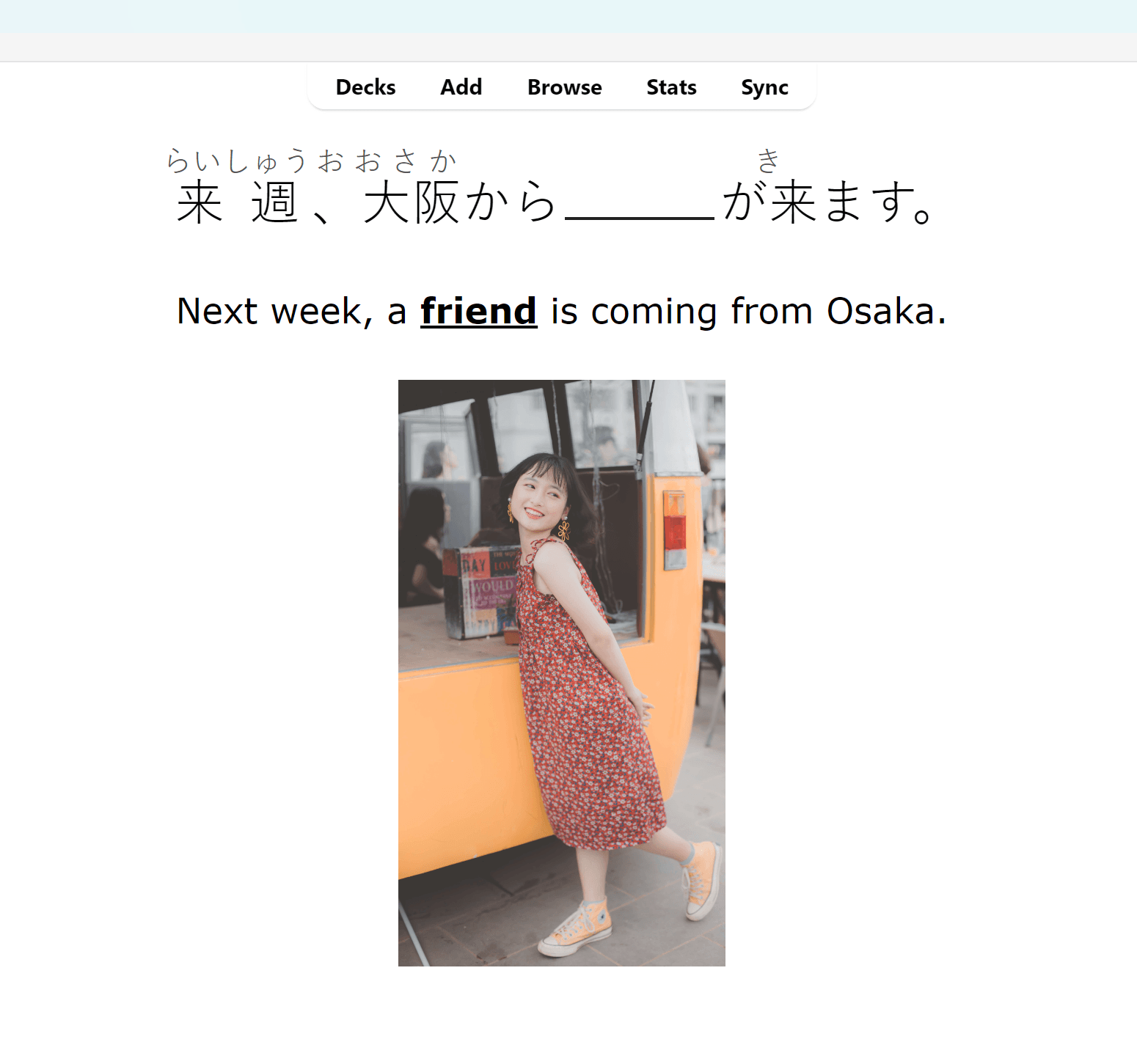
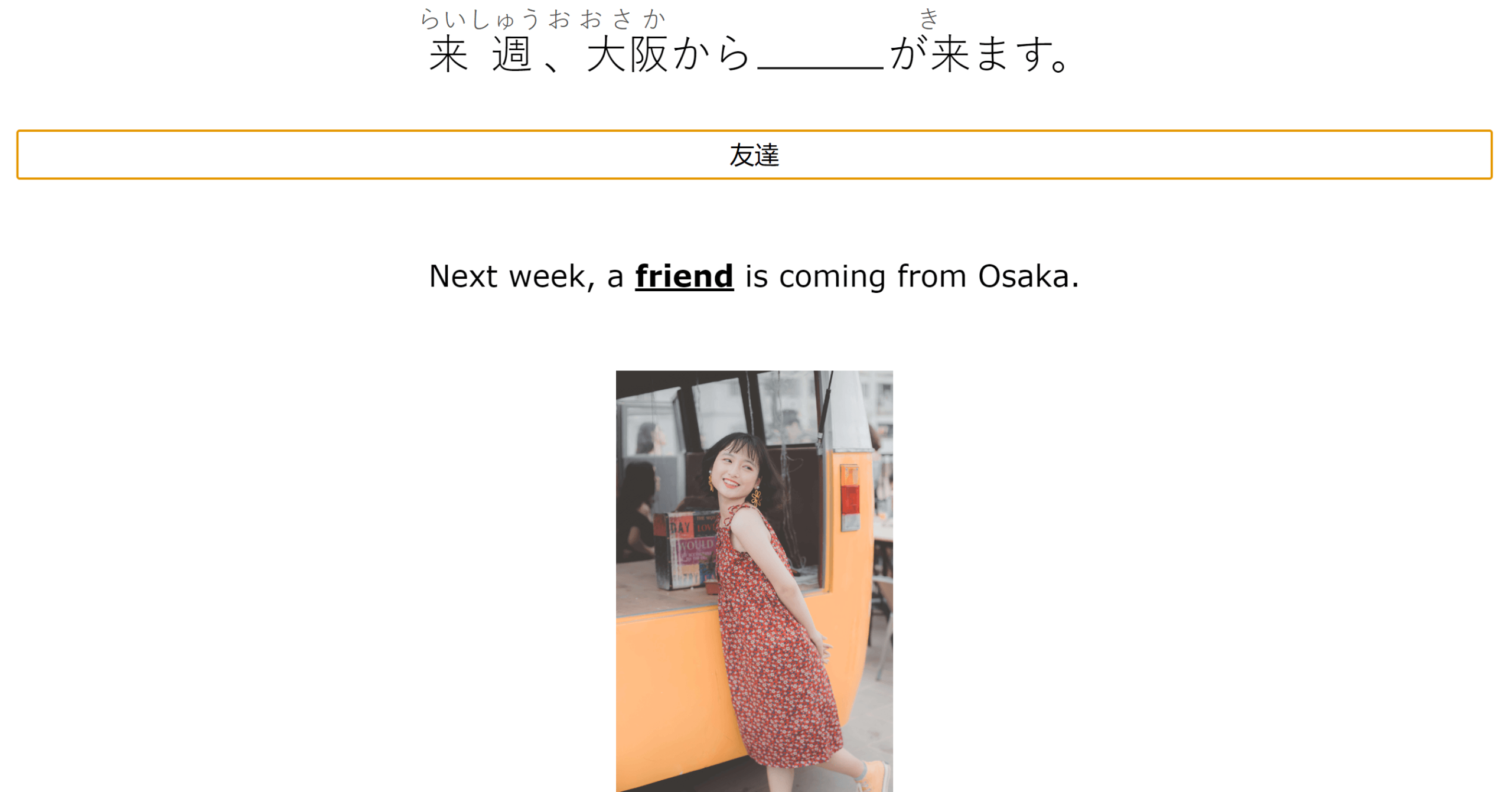
On the front side, you will find a sentence in both Japanese and English. This is accompanied by an image that shows the context of the sentence. In the Japanese sentence, the word you need to know is missing and represented as a blank. In the English sentence, the word you need to know is bolded and underlined. You should determine what belongs in place of the blank.
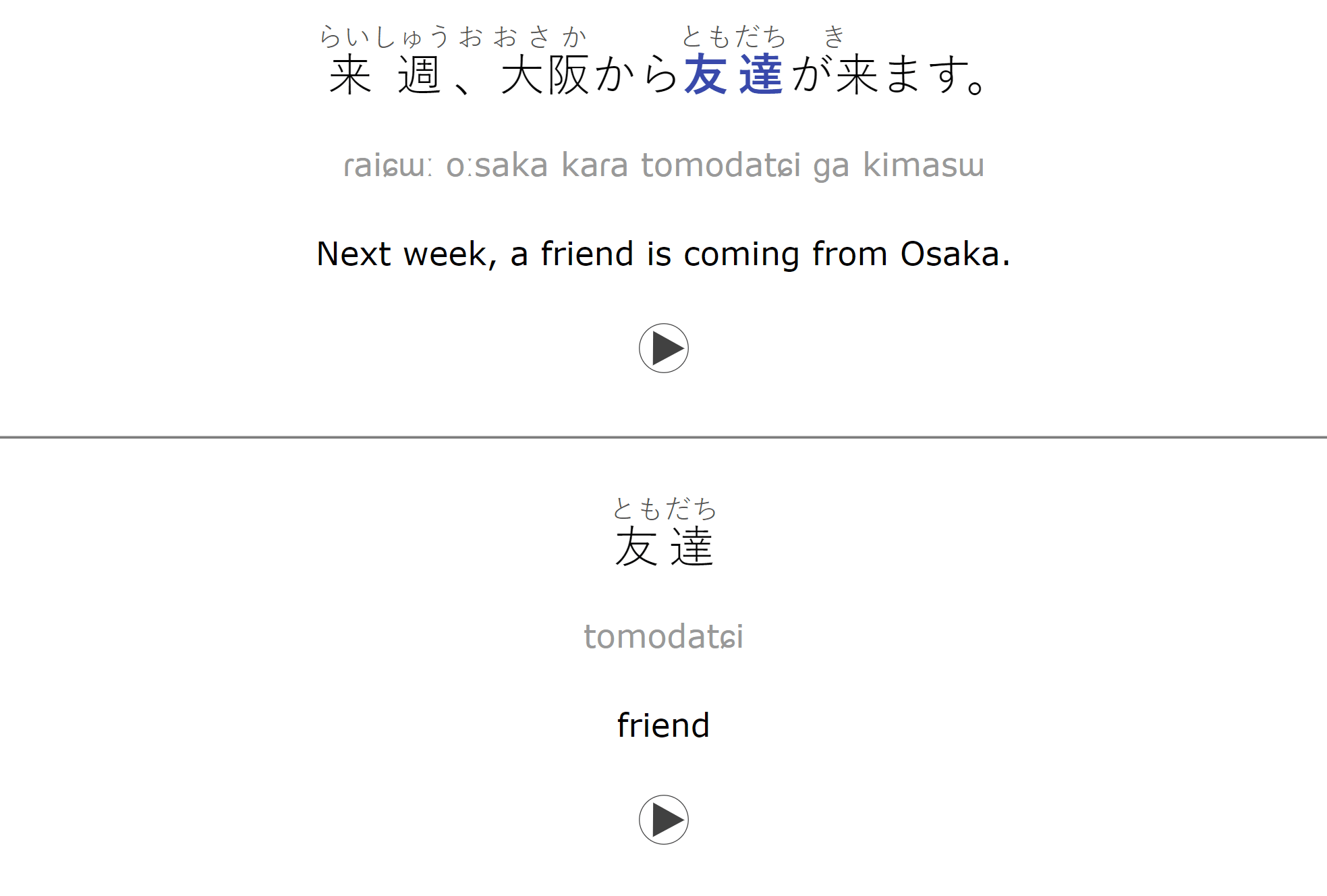
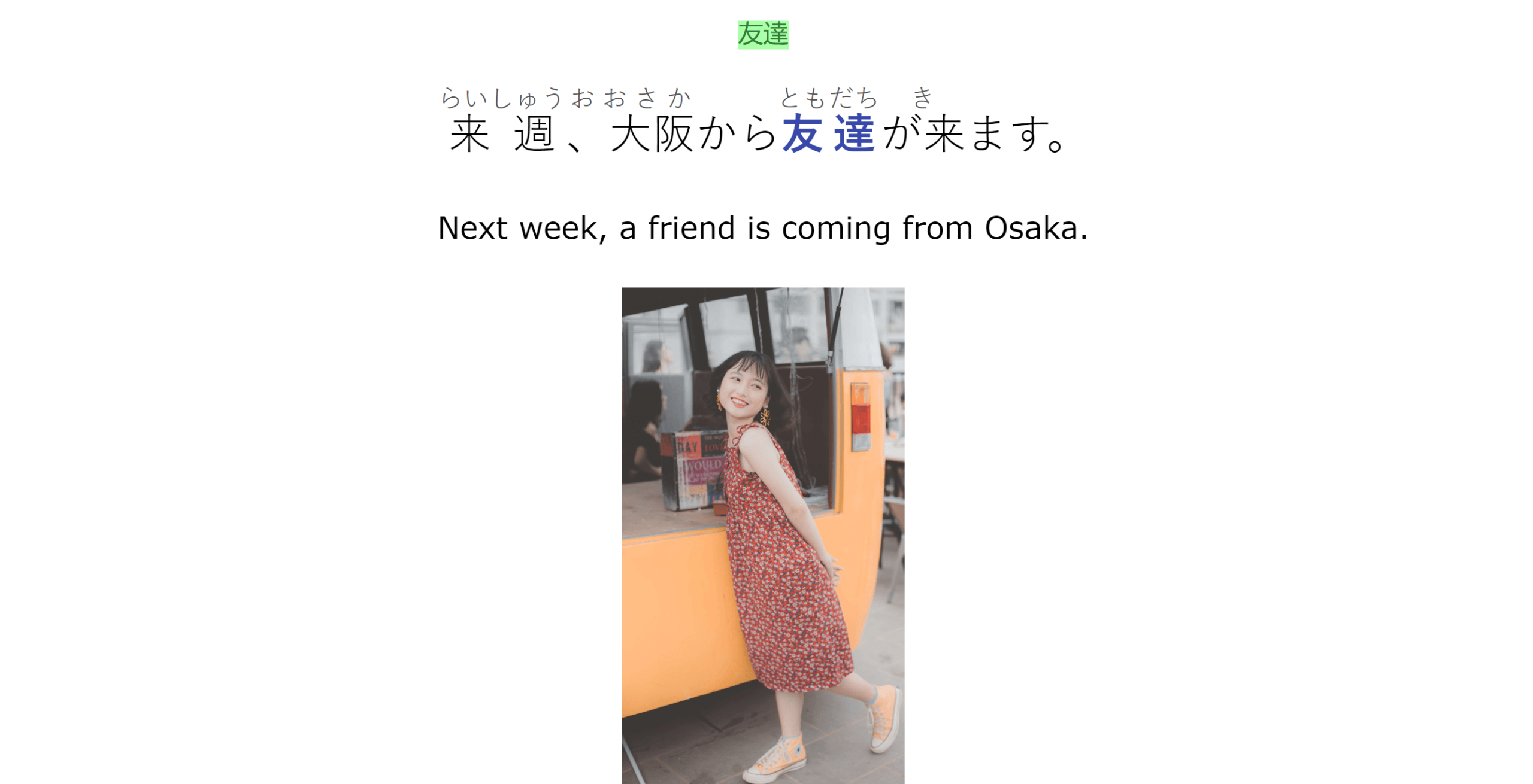
On the back, you will see the full Japanese sentence with the target word highlighted in indigo. This is so you can immediately spot the answer. Below that you will find the IPA transcription of the sentence, the English translation, and an audio file of the sentence.
For verbs, the card shows two forms of the word:
- The polite form (ます form, e.g. 食べます) comes first, as this is the form you will actually use in everyday conversation.
- The dictionary form (e.g. 食べる) comes second, as this is the form used in dictionaries and grammar references.
Each form is accompanied by its IPA transcription, English translation, and audio file, so you can hear exactly how each form sounds.
For nouns, adjectives, adverbs, and other word classes, only one form is shown. These words do not have a separate polite/dictionary distinction the way verbs do.
You will also see just the Japanese word, its IPA transcription, its English translation, and an audio file of the word. This allows you to see and hear the word in a sentence and just by itself.
Japanese A1 Vocabulary Anki Deck
The Japanese A1 Vocabulary Anki Deck is your first big step in your Japanese learning journey.
It will take about 30-40 hours to finish.
Once you are done you will have acquired the following skills:
- You are able to understand familiar words and very basic phrases concerning yourself, your family, and when people speak slowly and clearly.
- You can write short and simple postcards, and forms requiring personal details. Think of cards for holidays and subscription forms.
- You can use simple phrases. When conversing others need to speak slowly and help you in the conversation.
- You can understand familiar names, words, and very simple sentences, for example on notices and posters or in catalogues.
Japanese A2 Vocabulary Anki Deck
The Japanese A2 Vocabulary Anki Deck is your second big step in your Japanese learning journey.
It will take you cumulatively 80-100 hours to finish. So the hours reflect how much time you need for Japanese A1 + Japanese A2.
This means that this is the time it takes to finish everything before this and this one.
Once you are done you will have acquired the following skills:
- You can understand high-frequency words and often used expressions that are personally relevant (e.g. shopping, employment, and geography).
- You are able to write a simple letter and a simple message. You are capable of thanking someone for something that he or she has done.
- You can communicate in simple and routine tasks requiring a simple and direct exchange of information on familiar topics and activities.
- You can read very short, simple texts such as advertisements, prospectuses, menus and timetables and you can understand short simple personal letters.
Japanese B1 Vocabulary Anki Deck
The Japanese B1 Vocabulary Anki Deck is your third big step in your Japanese learning journey.
It will take you cumulatively 180-200 hours to finish. So the hours reflect how much time you need for Japanese A1 + Japanese A2 + Japanese B1.
Once you are done you will have acquired the following skills:
- You can read very short, simple texts such as advertisements, prospectuses, menus and timetables and you can understand short simple personal letters.
- You can write simple connected text on topics that are familiar or of personal interest, and write personal letters describing your experiences.
- You can describe experiences and events, dreams, hopes and ambitions and give reasons and explanations for opinions and plans.
- You can understand texts that consist mainly of high-frequency everyday or job-related language, and letters containing: events, feelings, and wishes.
Japanese B2 Vocabulary Anki Deck
The Japanese B2 Anki Deck is your fourth big step in your Japanese learning journey.
It will take you cumulatively 280-325 hours to finish. So the hours reflect how much time you need for Japanese A1 + Japanese A2 + Japanese B1 + Japanese B2.
Once you are done you will have acquired the following skills:
- You can understand extended speech and lectures and follow even complex lines of argument provided the topic is reasonably familiar. You can understand most TV news and current affairs programmes.
- You can produce clear, detailed text on a wide range of subjects and explain a viewpoint on a topical issue giving the advantages and disadvantages of various options.
- You can interact with a degree of fluency and spontaneity that makes regular interaction with native speakers quite possible without strain for either party.
- Can understand the main ideas of complex text on both concrete and abstract topics, including technical discussions in their field of specialization.
With all of these Japanese Anki Decks you will become fluent in Japanese!